
Efficacy of bamboo as an alternative substrate for cage culture of abalone Haliotis asinina Linnaeus, 1758
##plugins.themes.bootstrap3.article.sidebar##
##plugins.themes.bootstrap3.article.main##

Abstract
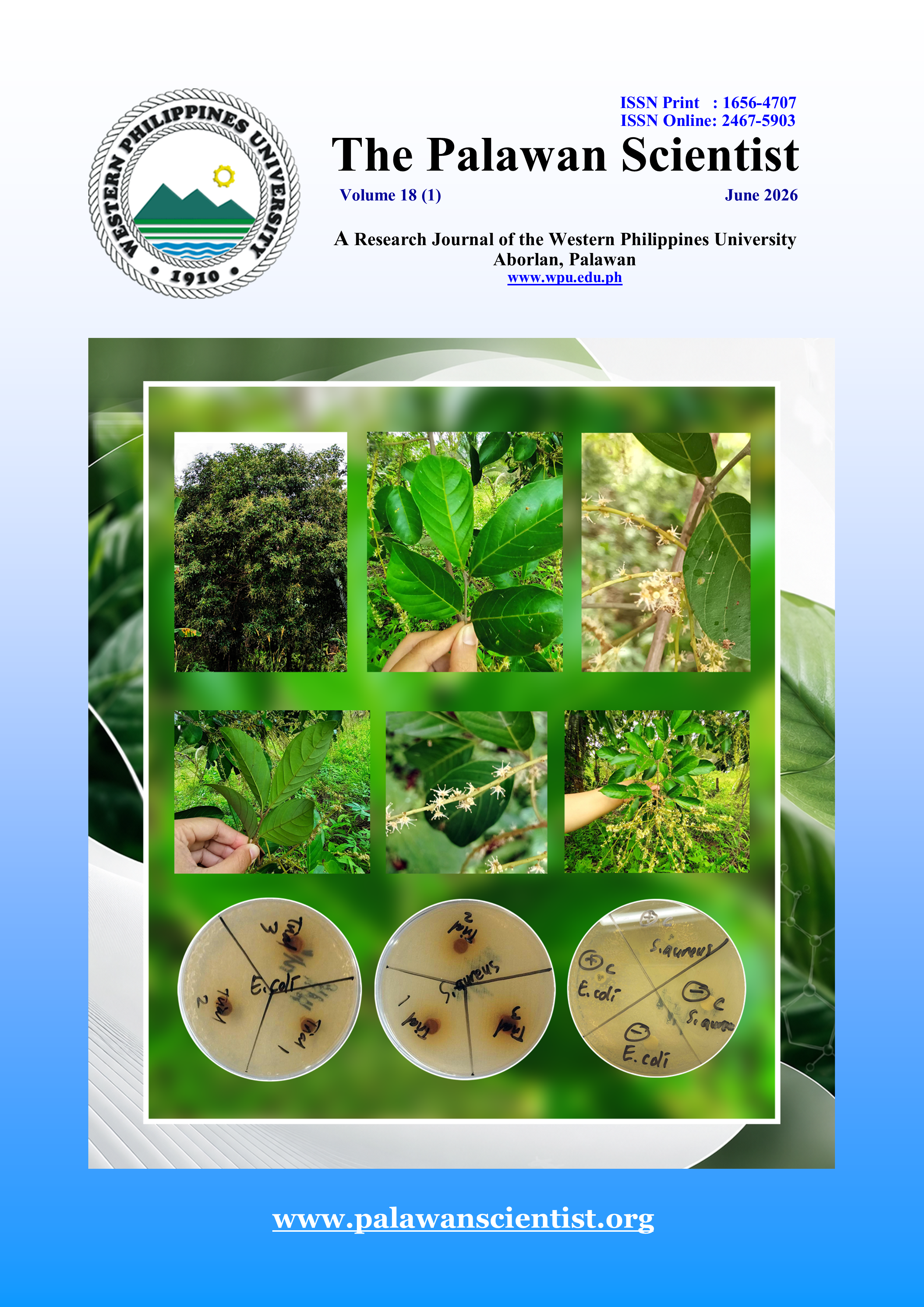
Abalone is a highly valued marine gastropod with a declining wild population due to increased fishing pressure. To meet market demand, there is growing interest in the cage culture of abalone juveniles. However, the most commonly used substrate in cage culture, polyvinyl chloride (PVC), has been linked to environmental and health risks. This study examined the efficacy of bamboo as an alternative substrate for the bottom and suspended cage culture of tropical abalone Haliotis asinina Linnaeus, 1758. Two culture experiments were conducted using (1) sea bottom cages and (2) suspended sea cages in Binduyan, Puerto Princesa City, and Pamantolon, Taytay, Palawan, respectively. Abalone juveniles grown with bamboo substrate (BS) had significantly higher weight gain, specific growth rate, and shell length growth rate compared to those reared with PVC substrate (PS) (P < 0.05). In addition, after 90 days and 150 days of culture, abalone juveniles on BS exhibited positive allometric growth compared to those on PS, which showed isometric growth. Moreover, the survival rates of abalone juveniles with BS were not significantly different from those with PS at P < 0.05. These findings suggest that BS is a viable alternative to PS for abalone juvenile culture, as it is indigenous, inexpensive, and environmentally friendly. The study's results can promote sustainable aquaculture practices for abalone while raising awareness of the potential environmental and health risks associated with PVC for cultured abalone and humans consuming cultured abalone.
How to Cite
Downloads
##plugins.themes.bootstrap3.article.details##
allometric, bottom sea cage, growth rate, isometric, PVC, suspended sea cage
Aspe NM, Cabales RG, Sajorne RE and Creencia LA. 2019. Survey on the predators of abalone Haliotis asinina from the perspective of the local fisherfolks in selected sites of Palawan, the Philippines. Journal of Shellfish Research. 38(2):463-473. https://doi.org/10.2983/035.038.0230
Aviles JGG and Shepherd SA. 1996. Growth and survival of the blue abalone Haliotis fulgens in barrels at Cedros Island, Baja California, with a review of abalone barrel culture. Aquaculture. 140(1-2):169–176. https://doi.org/10.1016/0044-8486(95)01199-4
Bautista-Teruel MN and Millamena OM. 1999. Diet development and evaluation for juvenile abalone, Haliotis asinina: protein/energy levels. Aquaculture. 178(1-2):117–126. https://doi.org/10.1016/S0044-8486(99)00121-0
Capinpin Jr EC and Corre KG. 1996. Growth rate of the Philippine abalone, Haliotis asinina fed an artificial diet and macroalgae. Aquaculture. 144(1-3):81–89. https://doi.org/10.1016/S0044-8486(96)01332-4
Capinpin Jr EC, Encena II VC and Bayona NC. 1998. Studies on the reproductive biology of the Donkey’s ear abalone, Haliotis asinina Linné. Aquaculture. 166(1-2):141–150. https://doi.org/10.1016/S0044-8486(98)00275-0
Capinpin Jr EC, Toledo JD, Encena II VC and Doi M. 1999. Density-dependent growth of the tropical abalone Haliotis asinina in cage culture. Aquaculture. 171(3-4):227–235. https://doi.org/10.1016/S0044-8486(98)00490-6
Creencia LA, Palla H, Peneyra J and Manlavi M. 2019. Development of bottom housing system for abalone farming. Project Terminal Report, DOST-PCIEERD. https://pcieerd.dost.gov.ph/pmis/view.php?id=RGpMV0JBPT0=. Accessed on 04 February 2025.
Creencia LA, Baldevieso AAG, Lota BH and Valoroso AD. 2021. Palawan Knowledge Platform for Biodiversity and Sustainable Development. https://pkp-new.pcsd.gov.ph/culture-of-abalone-haliotis-asinina-in-bottom-cages-with-bamboo-substrates/. Accessed on 17 February 2023.
Daw M. 2022. AI advancing for abalone. In: Fisheries Research and Development Corporation. https://www.frdc.com.au/ai-advancing-abalone. Accessed on 19 February 2023.
De Guzman AL and Creencia LA. 2014. Fecundity and condition factor of abalone Haliotis asinina broodstock conditioned in banana leaf and “buho” slat substrates. The Palawan Scientist. 6:1–13. https://doi.org/10.69721/TPS.J.2014.6.1.01
Ebert E and Houk J. 1984. Elements and innovations in the culture of red abalone, Haliotis rufescens. Aquaculture. 39(1-4):375–392. https://doi.org/10.1016/0044-8486(84)90279-5
Fermin AC. 2001. Abalone culture: an emerging aquaculture technology. In Fishlink 2001, 29-31 May 2001, Sarabia Manor Hotel, Iloilo City,. Iloilo City, Philippines: University of the Philippines Aquaculture Society. 8pp.
Fermin AC and Buen SMB. 2002. Grow-out culture of tropical abalone, Haliotis asinina (Linnaeus) in suspended mesh cages with different shelter surface areas. Aquaculture International. 9(6):499-508. https://doi.org/10.1023/A:1020535301193
Gapasin RSJ and Polohan BB. 2005. Response of the tropical abalone, Haliotis asinina, larvae on combinations of attachment cues. Hydrobiologia. 548:301–306. https://doi.org/10.1007/s10750-005-0754-8
Gonzales BJ. 2015. Abalone aquaculture for stock enhancement and community livelihood project in northern Palawan, Philippines. In: Romana-Eguia MRR, Parado-Estepa FD, editors. International Workshop on Resource Enhancement and Sustainable Aquaculture Practices in Southeast Asia 2014. Southeast Asian Fisheries Development Center/Aquaculture Department. pp. 137–146.
Health Care Without Harm Europe. 2021. The polyvinyl chloride debate: Why PVC remains a problematic material. https://noharm-europe.org/documents/polyvinyl-chloride-debate-why-pvc-remains-problematic-material. Accessed on 04 February 2025.
Hooper C, Day R, Slocombe R, Benkendorff K and Handlinger J. 2011. Effect of movement stress on immune function in farmed Australian abalone (hybrid Haliotis laevigata and Haliotis rubra). Aquaculture. 315(3-4):348–354. https://doi.org/10.1016/j.aquaculture.2011.02.012
Keshavanath P, Gangadhar B, Ramesh TJ, van Dam AA, Beveridge MCM and Verdegem MCJ. 2004. Effects of bamboo substrate and supplemental feeding on growth and production of hybrid red tilapia fingerlings (Oreochromis mossambicus×Oreochromis niloticus). Aquaculture. 235(1-4):303–314. https://doi.org/10.1016/j.aquaculture.2003.12.017
Le Cren ED. 1951. The length-weight relationship and seasonal cycle in gonad weight and condition in perch (Perca fluvialitis). Journal of Animal Biology. 20(2):201–219. https://doi.org/10.2307/1540
Mai K, Mercer JP and Donlon J. 1996. Comparative studies on the nutrition of two species of abalone, Haliotis tuberculata L. and Haliotis discus hannai Ino. V. The role of polyunsaturated fatty acids of macroalgae in abalone nutrition. Aquaculture. 139(1-2):77–89. https://doi.org/10.1016/0044-8486(95)01158-7
McShane PE, Smith MG and Beinssen KHH. 1988. Growth and morphometry in abalone (Haliotis rubra Leach) from Victoria. Marine and Freshwater Research. 39(2):161–666. https://doi.org/10.1071/MF9880161
Minh ND, Petpiroon S, Jarayabhand P, Meksumpun S and Tunkijjanukij S. 2010. Growth and survival of abalone, Haliotis asinina Linnaeus 1758, reared in suspended plastic cages. Kasetsart Journal - Natural Science. 44(4):621–630.
Najmudeen TM. 2015. Biometric relationships of the Indian abalone Haliotis varia Linnaeus 1758 from Mandapam waters of Gulf of Mannar, south-east coast of India. Indian Journal of Fisheries. 62(3):146–150.
Osmanski S. 2020. Why is PVC Bad for the Environment? Greenmatters. https://www.greenmatters.com/p/why-is-pvc-bad-environment. Accessed on 04 February 2025.
Poore GCB. 1972a. Ecology of New Zealand abalones, haliotis species (Mollusca: Gastropoda): 1. Feeding. New Zealand Journal of Marine and Freshwater Research. 6(1–2):11–22. https://doi.org/10.1080/00288330.1977.9515407
Poore GCB. 1972b. Ecology of New Zealand abalones, Haliotis species (Mollusca: Gastropoda): 3. Growth. New Zealand Journal of Marine and Freshwater Research. 6(4):534–559. https://doi.org/10.1080/00288330.1972.9515445
Schiel DR and Welden BC. 1987. Responses to predators of cultured and wild red abalone, Haliotis rufescens, in laboratory experiments. Aquaculture. 60(3-4):173–188. https://doi.org/10.1016/0044-8486(87)90286-9
SEAFDEC (Southeast Asian Fisheries Development Center). 2000. Abalone seed production and culture. https://www.seafdec.org.ph/wp-content/content/pages/freedownloads/flyers/ABALONE.PDF. Accessed on 04 February 2025.
SEAFDEC/AQD (Southeast Asian Fisheries Development Center/Aquaculture Department). 2022. Farming Abalone. In: SEAFDEC/AQD. https://www.seafdec.org.ph/abalone/. Accessed on 04 February 2025.
Setyono DED. 2005. Abalone (Haliotis asinina L): Early juvenile rearing and ongrowing culture. Oseana. 30(2):1–10.
Setyono DED. 2015. Rearing of juvenile donkey-ear abalone (Haliotis asinina) in flow-through tanks with the addition of different substrates. Marine Research in Indonesia. 40(1):17–22. https://doi.org/10.14203/mri.v40i1.70
Setyono DED. 2007. Stocking density for juvenile tropical abalone Haliotis asinina reared in structures suspended offshore. Indonesian Institute of Sciences. 33:213–226.
Shepherd SA. 1973. Studies on southern Australian abalone (Genus Haliotis). I. Ecology of five sympatric species. Marine and Freshwater Research. 24(3):217–258. https://doi.org/10.1071/MF9730217
Smith A, Aguilar JD, Boch C, De Leo G, Hernández‐Velasco A, Houck S, Martinez R, Monismith S, Torre J, Woodson CB and Micheli, F. 2022. Rapid recovery of depleted abalone in Isla Natividad, Baja California, Mexico. Ecosphere. 13(3):e4002. https://doi.org/10.1002/ecs2.4002
Steinarsson A and Imsland AK. 2003. Size dependent variation in optimum growth temperature of red abalone (Haliotis rufescens). Aquaculture. 224(1-4):353–362. https://doi.org/10.1016/S0044-8486(03)00241-2
Suleria HAR, Masci PP, Addepalli R, Chen W, Gobe GC and Osborne SA. 2017a. In vitro anti-thrombotic and anti-coagulant properties of blacklip abalone (Haliotis rubra) viscera hydrolysate. Analytical and Bioanalytical Chemistry. 409:4195–4205. https://doi.org/10.1007/s00216-017-0367-x
Suleria HAR, Masci PP, Gobe GC and Osborne SA. 2017b. Therapeutic potential of abalone and status of bioactive molecules: A comprehensive review. Critical Reviews in Food Science and Nutrition. 57(8):1742–1748. https://doi.org/10.1080/10408398.2015.1031726
Surtida AP. 2000. Abalone. SEAFDEC Asian Aquaculture. 22(4):14–15, 28.
Tegner MJ, Breen PA and Lennert CE. 1989. Population biology of red abalones (Haliotis rufescens) in southern California and management of the red and pink (H. corrugata) abalone fisheries. Fishery Bulletin. 87(2):313–339.
Tutschulte TC and Connel JH. 1988. Growth of three species of abalones (Haliotis) in Southern California. The Veliger. 31:(3/4):204-213.
Wahab MA, Mannan MA, Huda MA, Azim ME, Tollervey AG and Beveriddge MCM. 1999. Effects of periphyton grownn bamboo substrates on growth and production of Indian major carp, rohu (Labeo rohita Ham.). Bangladesh Journal of Fisheries Research. 3 (1):1–10.
Zhang N, Li H, Jeppesen E and Li W. 2013. Influence of substrate type on periphyton biomass and nutrient state at contrasting high nutrient levels in a subtropical shallow lake. Hydrobiologia. 710:129–141. https://doi.org/10.1007/s10750-012-1287-6

This work is licensed under a Creative Commons Attribution-NonCommercial 4.0 International License.