
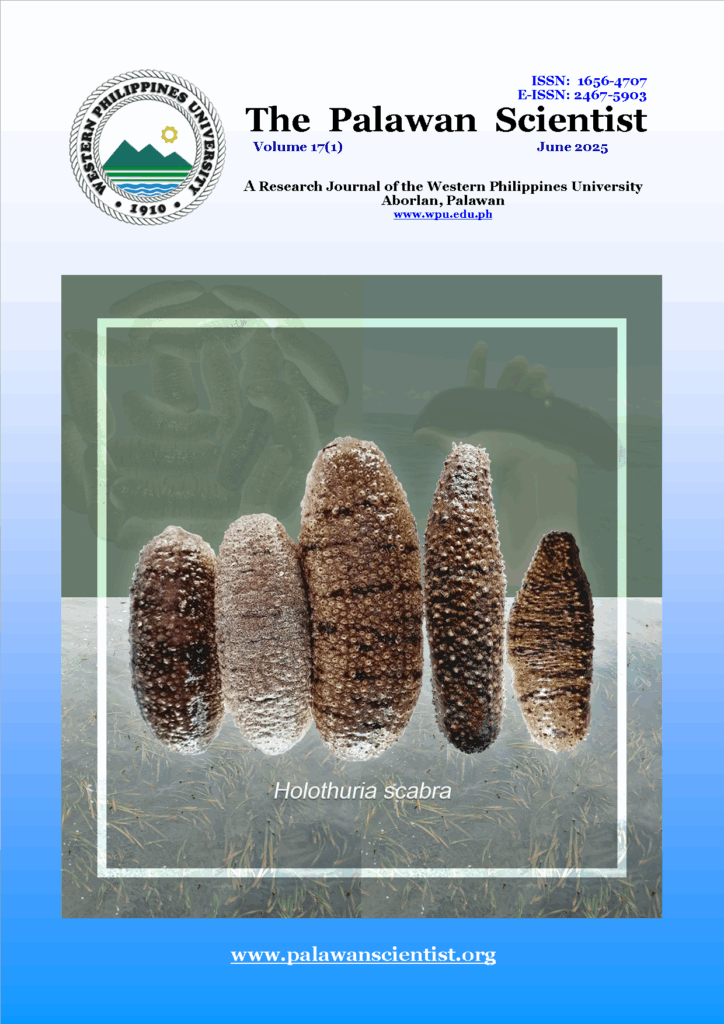
Survival and growth performance of sub-adult sandfish Holothuria scabra (Jaeger, 1833) in tanks with different supplemental feeds
##plugins.themes.bootstrap3.article.sidebar##
##plugins.themes.bootstrap3.article.main##

Abstract
Sandfish (Holothuria scabra Jaeger, 1833) is one of the most valuable sea cucumbers in local and international markets. Although listed as an endangered species, it is among the regularly harvested marine resources in Palawan, Philippines. To continue the trade of sandfish without harvesting from the wild, this study initially ventured into producing seed stocks. However, broodstocks were scarce, only sub-adults were available, and they needed to grow into broodstocks. This study evaluated the survival and growth performance of sub-adult sandfish when fed with soya bean powder (Treatment 1/T1), rice bran (Treatment 2/T2), and powdered seagrass leaves (Treatment 3/T3). Each treatment and control (no supplemental feeding) had three replicates with three sandfish having 59.55 ± 10.24 g mean weight and 9.74 ± 0.98 cm mean length. The samples were cultured in aerated plastic tanks (63.5 cm × 45.72 cm × 35.56 cm) with a 10 cm layer of sandy-muddy sediment filled with 40 L seawater, which was changed twice a day. Results showed 100% survival in T3 and control, 66% in T1, and 0% in T2. The mean weight and length were stable in the first two weeks of culture in all treatments and control, but the latter declined during the 3rd and 4th weeks of culture (P < 0.05). Such was attributed to the drop in salinity during the 3rd week. Nevertheless, seagrass powder and soya beans appeared to help maintain the growth and tolerance to stress of sub-adult sandfish while unprocessed rice bran was detrimental to the health of sub-adult sandfish and caused mortality before the end of the culture period.
How to Cite
Downloads
##plugins.themes.bootstrap3.article.details##
juvenile, mariculture , rice bran, seagrass, soya
Agudo N. 2006. Sandfish hatchery techniques. Australian Centre for International Agricultural Research, Secretariat of the Pacific Community, WorldFish Center, Noumea, New Caledonia. 45pp.
Altamirano JP, Recente CP and Rodriguez Jr. JC. 2017. Substrate preference for burying and feeding of sandfish Holothuria scabra juveniles. Fisheries Research, 186(Part 2): 514–523. https://doi.org/10.1016/j.fishres.2016.08.011
Altamirano JP and Noran-Baylon RD. 2020. Nursery culture of sandfish Holothuria scabra in sea-based floating hapa nets: effects of initial stocking density, size grading, and net replacement frequency. Aquaculture, 526(Part 2): 735379.
https://doi.org/10.1016/j.aquaculture.2020.735379
Battaglene SC. 1999. Culture of tropical sea cucumbers for stock restoration and enhancement. The International Center for Living Aquatic Resources Management Quarterly, 22(4): 4-11.
Brown EO, Perez ML, Garces LR, Ragaza RJ, Bassig RA and Zaragoza EC. 2010. Value chain analysis for sea cucumber in the Philippines. Studies and Reviews 2120. The Worldfish Center, Penang, Malaysia, pp. 44.
Cabansag JBP and Romero MM. 2014. Some data on the diversity and sexual maturity of sea cucumbers in the mangroves of Babatngon, Leyte Province, Philippines. South Pacific Commission Beche-de-mer Information Bulletin, 34: 25-28.
Choo PS. 2008. The Philippines: a hotspot of sea cucumber fisheries in Asia. In: Toral-Granda V, Lovatelli A and Vasconcellos M. (eds.). Sea Cucumbers. A Global Review of Fisheries and Trade. Food and Agriculture Organization of the United Nations, Fisheries and Aquaculture Technology, Rome, pp. 119–140.
DA-BFAR (Department of Agriculture-Bureau of Fisheries and Aquatic Resources). 2021. Philippine Fisheries Profile. 182pp. https://www.bfar.da.org.ph. Accessed on 06 April 2023.
Dolorosa RG, Salazar CB, Delfin MTV, PAduga JR and Balisco RAT. 2017. Sea cucumber fisheries in Rasa Island Wildlife Sanctuary, Narra, Palawan, Philippines. SPC Beche-de-mer Information Bulletin, 37: 9-20.
Dolorosa RG and Jontila JBS. 2012. Notes on common macrobenthic reef invertebrates of Tubbataha Reefs Natural Park, Philippines. Science Diliman, 24(2): 1-11.
Dolorosa RG. 2015. The sea cucumbers (Echinodermata: Holothuroidea) of Tubbataha Reefs Natural Park, Philippines. SPC Beche-de-mer Information Bulletin, 35: 10-18.
Dumalan RJP, Bondoc KGV and Juinio-Menez MA. 2019. Grow-out culture trial of sandfish Holothuria scabra in pens near a mariculture-impacted area. Aquaculture, 507: 481-492. https://doi.org/10.1016/j.aquaculture.2019.04.045
Floren A, Hayashizaki K, Tuntiprapas P and Prathep A. 2021. Contributions of seagrasses and other sources to sea cucumber diets in a tropical seagrass ecosystem. Chiang Mai Journal of Science, 48(5): 1259–1270.
Hamel JF, Mercier A, Conand C, Purcell SW, Toral-Granda TG and Gamboa R. 2013. Holothuria scabra. The IUCN Red List of Threatened Species 2013: e. T180257A1606648. The IUCN Red List of Threatened Species. 12pp. http://dx.doi.org/10.2305/IUCN.UK.2013-1.RLTS.T180257A1606648.en
Jontila JBS, Balisco RAT and Matillano JA. 2014. The sea cucumbers (Holothuriodea) of Palawan, Philippines. International Journal of the Bioflux Society, 7(3): 194-206.
Jontila JBS, Gonzales R, Villanueva R, Llavan N and Juinio-Meñez MA. 2018. Survival and growth of sandfish (Holothuria scabra) juveniles in floating hapa. Unpublished manuscript.
Jontila JBS. 2023. The sea cucumbers of Palawan, Philippines: A field guide. In: Dolorosa RG (ed). Western Philippines University, Philippines, pp. 1-92.
Juinio-Meñez MA, de Peralta G, Dumalan RJP, Edullantes CMA and Catbagan TO. 2012. Ocean nursery systems for scaling up juvenile sandfish (Holothuria scabra) production: ensuring opportunities for small fishers. Australian Center for International Agricultural Research Proceedings, 136: 57-62.
Juinio-Meñez MA, Evangelio JC and Miralao SJA. 2014. Trial grow-out culture of sea cucumber Holothuria scabra in sea cages and pens. Aquaculture Research, 45(8): 1332-1340. https://doi.org/10.1111/are.12078
Juinio-Meñez MA, Tech ED, Ticao IP, Gorospe JRC, Edullantes CMA and Rioja RAV. 2016. Adaptive and integrated culture production systems for the tropical sea cucumber Holothuria scabra. Fisheries Research, 186(Part 2): 502-513. http://dx.doi.org/10.1016/j.fishres.2016.07.017
Mackey A and Hentschel TB. 2001. Factors That Influence the Reproduction of Sea Cucumbers. San Diego State University, United States. https://scholar.google.com/scholar?q=Mackey+A+and+Hentschel+B+2001+Factors+that+Influence+The+Reproduction+of+Sea+Cucumbers+%28San+Diego%3A+San+Diego+State+University%29. Accessed on 01 February 2023.
Mercier A, Battaglene SC and Hamel JF. 1999. Daily burrowing cycle and feeding activity of juvenile sea cucumbers Holothuria scabra in response to environmental factors. Journal of Experimental Marine Biology and Ecology, 239(1): 125–156. https://doi.org/10.1016/S0022-0981(99)00034-9
Olavides RDD, Edullantes CMA and Juinio-Meñez MA. 2010. Assessment of the sea cucumber resource and fishery in Bolinao-Anda reef system. Science Diliman, 22(2): 1-12.
Purcell SW. 2010. Managing sea cucumber fisheries with an ecosystem approach. In: Lovatelli A, Vasconcellos M. and Yimin Y. (eds). Food and Agriculture Organization of the United Nations, Fisheries and Aquaculture Technical Paper No. 520, Rome. 6pp.
Purcell SW, Hair CA and Mills DJ. 2012. Sea cucumber culture, farming, and sea ranching in the tropics: progress, problems, and opportunities. Aquaculture, 368-369: 68–81. http://dx.doi.org/10.1016/j.aquaculture.2012.08.053
Purcell SW, Williamson DH and Ngaluafe P. 2018. Chinese market prices of beche-de-mer: implications for fisheries and aquaculture. Marine Policy, 91: 58-65. https://doi.org/10.1016/j.marpol.2018.02.005
Schoppe S. 2000. Sea cucumber fishery in the Philippines. South Pacific Commission Beche-de-mer Information Bulletin, 13: 10-12.
Sembiring SBM, Wibawa GS, Hutapea JH and Giri INA. 2019. The effect of salinity on survival, growth, and immunity rate of sea cucumber (Holothuria scabra) juveniles. Biotropia, 26(3). https://doi.org/10.11598/btb.2019.26.3.1041
Short F, Carruthers T, Dennison W and Waycott M. 2007. Global seagrass distribution and diversity: a bioregional model. Journal of Experimental Marine Biology and Ecology, 350: 3–20. https://doi.org/10.1016/j.jembe.2007.06.012
Tuwo A, Yasir I, Tresnati J, Aprianto R, Yanti A, Bestari AD and Nakajima M. 2019. Evisceration rate of sandfish Holothuria scabra during transportation. Institute of Physics Conference Series Earth and Environmental Science, 370(1): 012039. https://doi.org/10.1088/1755-1315/370/1/012039

This work is licensed under a Creative Commons Attribution-NonCommercial 4.0 International License.