
Editorial
Predatory journals, high-quality science, research ethics, artificial intelligence: how confusing could digital academic publishing be?
Navigating the publishing process could be exhausting and puzzling for early career researchers. Having published in a predatory journal and from low-medium-to high-quality journals, with a Web of Science Impact Factor of <0.5 to a metric of 13.6, opens a broad perspective in scientific publishing. I, too, started my scientific publishing career, unknown to its depths. Excited for research, I gathered the data for six months, collated and interpreted the results for ~4 months, and wrote, edited, reviewed, and rewrote the paper for over six months. For the sake of publication at the state universities and colleges, for institutional evaluation purposes, and deadlines, but mainly due to the lack of awareness of the publication and scientific publishing, these efforts became rubbish: the fact of getting published in a low-quality, unknown journal, potentially predatory, without proper technical, scientific scrutiny—where no one reads and recognizes.
Acknowledging predatory publishing as a global problem is a way to combat bad science. Unfortunately, good science is challenging to define, and in this digital era, how can an amateur researcher navigate the labyrinth of scientific publishing? Four significant issues and challenges in science are presented herein. First is (1) how predatory journals and publishers generally operate, 2) what high-quality science is, 3) how research ethics uplift standards, and 4) how to utilize and limit artificial intelligence as a tool in science. Luckily, a group of scientists published in “Nature” came up with the definition (Grudniewicz et al. 2019) of predatory journals:
“Predatory journals and publishers are entities that prioritize self-interest at the expense of scholarship and are characterized by false or misleading information, deviation from best editorial and publication practices, a lack of transparency, and/or the use of aggressive and indiscriminate solicitation practices.” Nature, 576: 210-212.
However, without experience, it is still problematic to evaluate which journal is predatory, even when it is free. These journals are very persistent: they send emails, praise your mediocre work, demand excessive open access fees, provide little to no editorial services, and offer rapid publication-often within days to weeks. These journals are mostly multidisciplinary and publish almost anything for money. To ensure quality publications, the simplest solution is to stick with the established and trusted indexing list, such as the Web of Science (WoS). The most impactful journals are covered under the WoS Core Collection Indexes: Science Citation Index (Expanded) (SCI & SCIE) and Social Science Citation Index (SSCI). Other core collections include the Arts and Humanities Citation Index (AHCI) and the Emerging Sources Citation Index (ESCI), good options for new researchers. Web of Science is an independent database and unassociated from any journal publisher. Still, some journals can be categorized as predatory within these indexes and difficult to spot. Overall, you can choose journals published for free by independent, recognized national or international organizations and established universities and are mainly indexed in high-quality indexes like the WoS SCIE.
High-quality science requires a broad definition in all aspects of the scientific process—from conceptualization, undertaking, and analysis to publication. The easiest, common way of evaluating scientific publications is based on journal metrics. The Declaration on Research Assessment (DORA) recommends assessing the scientific substance of a particular article using article-level metrics or context-specific metrics such as five-year impact factor, EigenFactor, SCImago, h-index, and editorial or publication times (DORA 2024). However, to evaluate the worth of research contributions, most universities employ citation counts, accepted lists of prestigious journals, or other criteria (Lindgreen et al. 2021). In transdisciplinary science, quality can be based on relevance, credibility, legitimacy, and effectiveness, the four basic tenets. These are grounded in social significance, integration, reflexivity, equitable representation of stakeholder interests, and real or potential contributions to social change and problem-solving (Belcher et al. 2016). However, “the concept of research excellence is ubiquitous, but its meaning depends on context” (Campbell 2018). It cannot be only based on metrics but on its impacts on society.
Research ethics is gaining more attention in the Philippines as malpractices gather social media attention (Facebook). One viral case was using a student’s thesis published solely by a Professor from the University of Southern Mindanao (posted May 6, 2024). Another was the allegedly plagiarized news article originally written by a student at Ateneo de Manila University (posted August 31, 2024), and for sure, many more. Research ethics should be made the foundation of research. High-quality journals always require research ethics approval and permits, accordingly, and using the norms and highest ethical standards uplifts one’s research quality. Developing research ethical practices as a culture rather than a requirement and incorporating them in all research curricula paves the way for our acceptance and awareness of these norms. Adding to the jargon in scientific publishing is artificial intelligence (AI). Inevitably, AI is a promising advance in scientific inquiry and offers a diverse use in all aspects of research i.e., planning-to-publication. Artificial Intelligence is used in science to improve experimental design, data gathering, interpretation, and hypothesis creation. This allows for the provision of insights that may not be possible with traditional approaches (Wang et al. 2023). However, using AI in manuscript writing poses issues with scientific integrity when carelessly done. Nowadays, many might use ChatGPT and the like to generate entire write-ups and then humanize them with another AI tool. However, this is unacceptable in science and additionally stunts someone’s scientific growth, critical thinking, and sense of responsibility. To uphold scientific integrity while utilizing powerful AI tools, AI in manuscript writing should only aid the authors by correcting grammar and clarifying sentence structures. One best example of these functions can be found, e.g., in Quilbott and Grammarly.
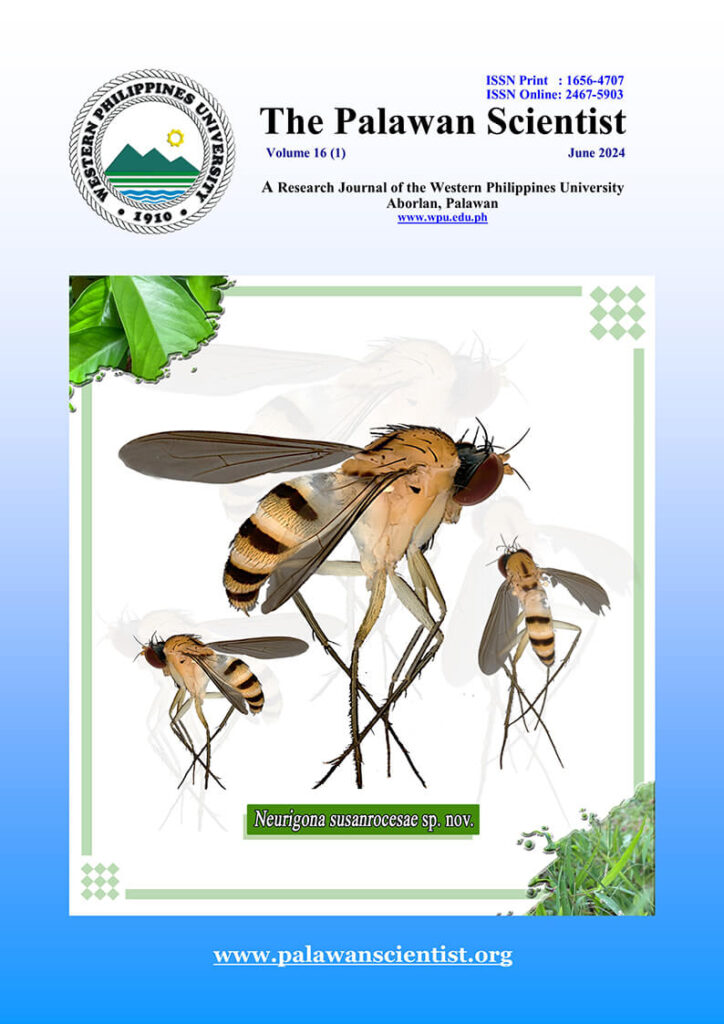
Where is the Palawan Scientist journal positioned in the Philippine academic publishing? To date, there are 17 Philippines journals indexed in the Web of Science Core Collection Indexes: SCI, SSCI, AHCI, and ESCI, which was included in the new Journal Citation Reports (JCR) 2023 (Clarivate 2023). JCR does not include journals in the Philippines indexed in Additional WoS Indexes, e.g., Biological Abstracts, BIOSIS Previews, Zoological Records, etc. The Palawan Scientist having its new Impact Factor (IF) and being included in the JCR this year creates a new avenue for quality metrics and journal ranking (IF: 0.1, Biology Category, Q4) (Clarivate 2023). The growth of the Palawan Scientist journal contributes to the development of Philippine science. Having 2 issues per year, getting an impact factor, this current issue’s discovery of a new species of long-legged fly Neurigona susanrocesae (Deocaris et al.), and papers authored throughout the Philippine archipelago, Indonesia, and Malaysia further marks the increasing international journal reputation. As a multidisciplinary journal, a variety of fields can be published, from biodiversity by Deocaris et al. and Mecha, fish genomics by Guia et al., fisheries management and society by Juan et al., Chelliah et al., and Labayo and Preña. The current issue also features chemical engineering technology by Junco et al. and educational management by Casinillo and Pentang et al. The Palawan Scientist offers a great avenue for quality research publication and guidance for young and expert scientists.
Everything is easier to navigate with a helping hand. The Palawan Scientist is here to guide your career to high-quality science for free! We welcome your submission to the Palawan Scientist journal.
Frank Paolo Jay B. Albarico, Ph.D.
Associate Editor, The Palawan Scientist
Assistant Professor, College of Hydrosphere Science, Research Fellow, Sustainable Environment Research Center,
National Kaohsiung University of Science and Technology, Taiwan
DOI: https://doi.org/10.69721/TPS.J.2024.16.1.01.x
Published: June 10, 2024