
Current Issue
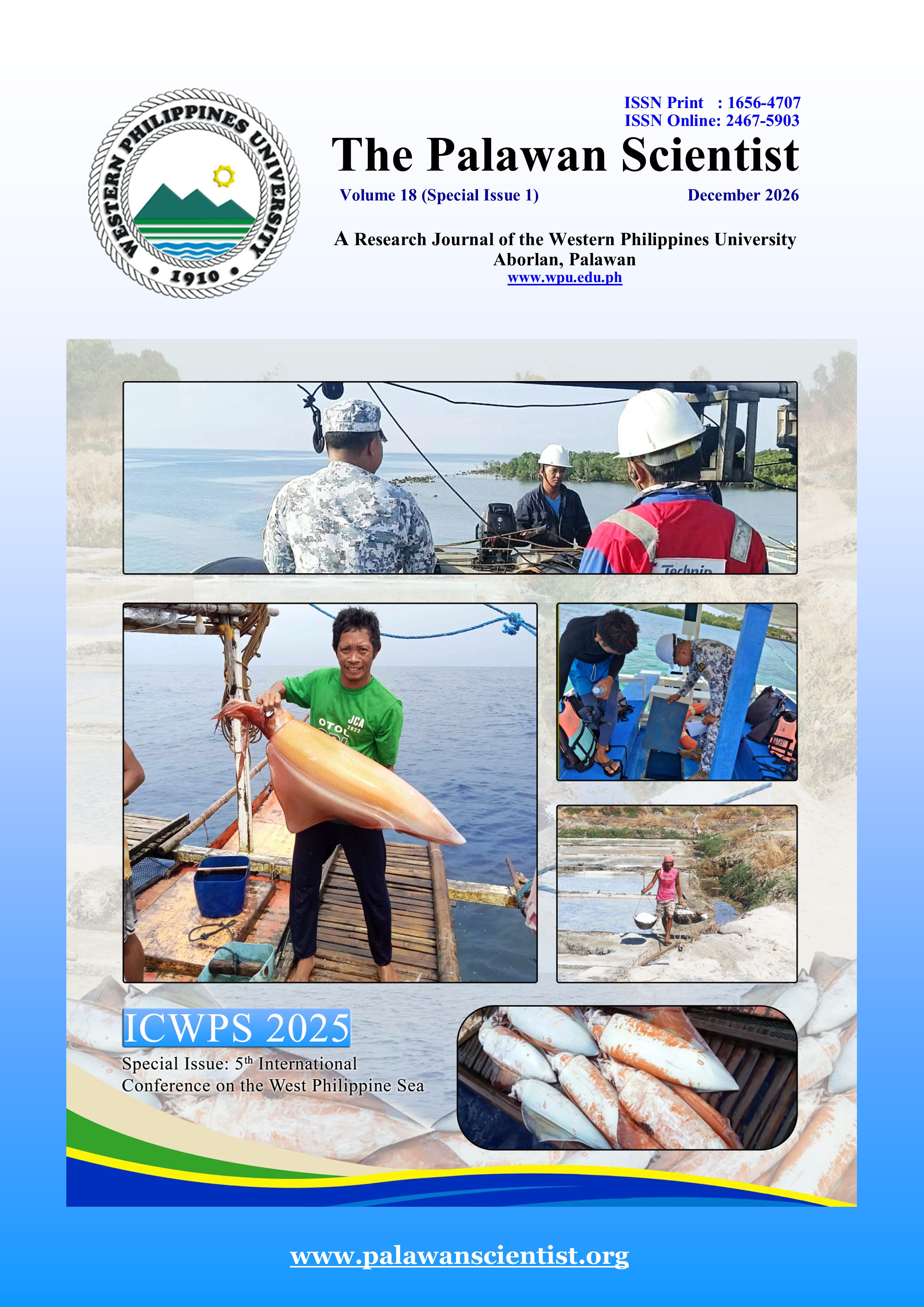
Vol. 18 No. Special Issue 1 (2026): The Palawan Scientist - Special Issue of the 5th International Conference on the West Philippines Sea
Editorial
Beyond the Waters of Palawan: Science, Communities, and Resilience in the West Philippine Sea
Dear Readers,
Understanding the West Philippine Sea requires looking beyond its waters to examine the biodiversity it sustains, the people who depend on its resources, the institutions responsible for its protection, and the coastal communities exposed to environmental and climate-related risks.
The West Philippine Sea (WPS) is a complex social–ecological system in which marine biodiversity, fisheries, livelihoods, human well-being, maritime governance, and environmental risks are closely interconnected. Its waters support marine food production and coastal livelihoods and form part of important international maritime navigation routes. Sustaining these resources is therefore essential to ecological integrity, socioeconomic well-being, and long-term regional resilience.
Despite research undertaken by various institutions, significant knowledge gaps remain that constrain evidence-based conservation and resource management. Understanding the WPS requires more than documenting its marine ecosystems and species; it also demands an assessment of the human activities, institutional capacities, and environmental pressures that shape the region. Reported concerns include habitat degradation, changes in island morphology, pollution, climate vulnerability, fishing pressure, and challenges in law enforcement. Addressing these concerns requires sustained scientific investigation, coordinated governance, and effective implementation of conservation and management measures.
Government agencies and research institutions have initiated efforts to address some of these challenges. Among them are the Palawan Council for Sustainable Development Staff (PCSDS) initiatives associated with the Integrated Management and Protection Strategies for Lawak Island Critical Habitat (LICH) and Safeguarding Ecological Abode for Turtles at Haven (SEA-TH): Initiatives for Likas Island Ecological Development. These initiatives support conservation efforts for migratory bird populations on Lawak Island and sea turtles on Likas Island. Nevertheless, challenges remain in systematic ecological and pollution monitoring, climate resilience, law enforcement, and the management of maritime and jurisdictional disputes. These concerns underscore the need for integrated, sustained, and science-based approaches to marine and coastal management.
The studies assembled in this special issue contribute to this broader understanding by examining fisheries, marine biodiversity, maritime services, disaster risk reduction, public health, coastal engineering, and coastal industries. Collectively, they demonstrate that knowledge of the WPS cannot be developed through a single discipline. Rather, it emerges from the convergence of diverse scientific approaches that generate local evidence for sustainable resource use, safer communities, stronger institutions, and more resilient coastal systems.
Biodiversity and Fisheries: Strengthening the Scientific Basis for Conservation
Reliable biodiversity assessments and fisheries information are fundamental to sustainable resource management. The study of the diamondback squid (Thysanoteuthis rhombus) fishery in Rizal, Palawan, provides baseline information on a locally recognized, high-value species known as “dalupapa.” Such documentation can inform future investigations of the fishery, including its exploitation patterns, ecological significance, and management requirements.
Similarly, the first documented record of the keeltail pomfret (Taractes rubescens) from Palawan expands the known marine biodiversity of the region, particularly its deeper and less-explored habitats. The study also demonstrates the potential value of local fish markets as sources of information on species occurrence and distribution. When supported by reliable identification and documentation, such records can contribute to biodiversity inventories, guide further research, and inform conservation assessments.
Together, these studies highlight the continuing need for taxonomic documentation, fisheries monitoring, and ecological research. Even in a region recognized for its rich marine resources, important questions remain about species distribution, population status, exploitation, and conservation. Translating these findings into management action requires sustained monitoring and the integration of scientific evidence into fisheries and coastal resource policies.
Coastal Livelihoods and Human Well-being
The sustainability of marine resources is inseparable from the socioeconomic conditions of the people who depend on them. The study of salt-making practices highlights the challenges confronting coastal producers, including exposure to climate and weather variability, limited access to larger distribution networks, inadequate storage, and insufficient post-harvest improvements. These constraints point to opportunities for climate-resilient infrastructure, appropriate technologies, improved storage and product handling, traceability systems, secure tenure arrangements, and stronger market linkages. Such interventions should be responsive to local production conditions and the needs of coastal livelihood groups.
The health-related study adds another dimension to coastal sustainability by examining the occupational and health concerns of people living and working in marine environments. The findings identify marine accidents, musculoskeletal complaints, and infections or skin diseases as important health-related concerns. More than half of the respondents had physical health scores at or below the study's specified threshold, while musculoskeletal complaints were particularly prevalent. The study also identified greater risks among women and respondents in lower marine-based income groups, underscoring the importance of gender-responsive safety measures, ergonomic support, accessible health services, and stronger social protection.
These findings broaden the understanding of coastal resource sustainability. Healthy marine ecosystems are essential, but so are the health, safety, and livelihood security of the people who depend on them. Fisheries management, occupational safety, public health, disaster preparedness, and livelihood development should therefore be addressed as interconnected components of coastal management rather than as separate policy concerns.
Maritime Institutions and Governance
Effective maritime governance depends not only on policies and institutional mandates but also on the capacities and working conditions of the personnel responsible for implementing them. The study examining the human dimension of Philippine Coast Guard personnel highlights their commitment to maritime service alongside challenges that include equipment deficiencies and unfavorable public perceptions.
The findings point to the importance of continuing professional development, adequate operational resources, evidence-informed decision-making, and stronger partnerships among maritime agencies, local governments, nongovernmental organizations, academic institutions, and coastal communities. Institutional capacity is particularly important in maritime areas where environmental protection, public safety, resource management, and the enforcement of applicable laws and regulations intersect.
Strengthening maritime governance consequently requires sustained investment in personnel, equipment, inter-agency coordination, and community engagement. Scientific research can support these efforts by providing information for planning, identifying operational and environmental concerns, and helping institutions develop responses that are appropriate to local conditions.
Environmental Change, Disaster Risk, and Coastal Resilience
Coastal resilience depends on institutional preparedness, community participation, and an understanding of the environmental risks affecting coastal areas. The assessment of disaster risk reduction and management awareness and practices among barangay officials in San Vicente, Palawan, found generally high awareness of search and rescue, official responsibilities, and evacuation facilities. However, limited training, inadequate funding, and low community participation remained important challenges. The reported relationship between disaster experience and disaster risk reduction practices also suggests that lessons from previous events can inform local preparedness and planning.
These findings highlight the importance of strengthening local capacity to respond to environmental hazards. While awareness among local officials provides an important foundation, effective disaster risk reduction also requires sustained institutional support, adequate resources, and meaningful community participation. In coastal areas exposed to environmental and climate-related risks, preparedness must be supported by locally grounded evidence and translated into practical measures that address the needs and vulnerabilities of affected communities.
More broadly, strengthening coastal resilience requires connecting scientific knowledge with local planning and decision-making. Research on disaster preparedness can help identify gaps in institutional capacity, inform targeted interventions, and support more responsive risk communication. Integrating these insights into local development planning and community-based initiatives is essential to reducing vulnerability and building resilience in coastal communities.
From Scientific Evidence to Integrated Action
Viewed collectively, the contributions in this special issue present a multidimensional picture of the WPS and its associated coastal environments. Their methods range from interviews and surveys to biodiversity documentation, statistical analysis, and hydrological modeling. Although the studies address different subjects and geographic settings, they share a common contribution: generating evidence that can help identify ecological conditions, socioeconomic constraints, institutional needs, and environmental risks.
A central lesson is the importance of locally grounded research. Challenges affecting marine ecosystems and coastal communities are experienced in specific places and under particular environmental, economic, and institutional conditions. Data derived from these settings can complement broader regional and national assessments by revealing local circumstances that generalized analyses may overlook. Continued research is therefore necessary not only to fill knowledge gaps but also to establish baselines, monitor change, evaluate interventions, and identify emerging management priorities.
However, scientific evidence alone does not guarantee effective conservation or improved community well-being. Research findings must be translated into practical decisions and sustained interventions. Fisheries data should inform resource assessment and management; biodiversity records should support continued monitoring and conservation; health research should guide improvements in occupational safety and access to health services; and disaster assessments should strengthen preparedness, early warning, and land-use planning. Likewise, research on coastal industries should inform appropriate technologies and livelihood development, while studies of maritime personnel should help identify priorities for institutional capacity-building.
Achieving these outcomes requires an integrated, interdisciplinary, and multisectoral approach to marine and coastal management in the WPS. Researchers, government agencies, maritime institutions, local governments, coastal industries, and communities must work collaboratively to connect scientific knowledge with policy formulation, enforcement, resource allocation, and community-based action. Such collaboration is particularly important where ecological conservation, livelihood security, climate adaptation, and maritime governance intersect.
Conclusion
The WPS demands scholarship that is scientifically rigorous, interdisciplinary, and responsive to the realities of coastal communities. The studies presented in this special issue contribute to that goal by documenting fisheries and biodiversity, examining the conditions of people who work in marine environments, assessing institutional challenges, and investigating coastal hazards and livelihood concerns. Individually, they provide findings relevant to specific research questions; collectively, they demonstrate the value of viewing marine and coastal environments as interconnected social–ecological systems.
This special issue of the International Conference on the West Philippine Sea represents a contribution to the continuing effort to understand these systems. Its significance lies not only in the findings of individual studies but also in the opportunities they create for further research, collaboration, and evidence-informed decision-making. From marine species and fisheries to maritime personnel, coastal health, disaster preparedness, and local industries, the studies emphasize that environmental sustainability and human well-being must be pursued together.
Ultimately, understanding the West Philippine Sea means understanding both its waters and the people whose lives are connected to them. Continued scientific investigation, systematic monitoring, institutional collaboration, and the translation of research into practical action are essential to safeguarding marine biodiversity, sustaining coastal livelihoods, strengthening maritime governance, and improving resilience to environmental and climate-related risks. The studies in this special issue should therefore be viewed not as a complete account of the WPS, but as a foundation for further inquiry and coordinated action toward a more informed, resilient, and sustainable future for its ecosystems and communities.
Maria Mojena Gonzales-Plasus
College of Fisheries and Natural Sciences,
Western Philippines University,
Puerto Princesa Campus 5300, the Philippines;
Conference Chair, 5th International Conference on West Philippine Sea
Benjamin J. Gonzales
BGERMC, Casuy Road, Purok El Rancho,
Barangay Santa Monica, Puerto Princesa City,
Palawan 5300, the Philippines;
Co-Chair and adviser, 5th International Conference on West Philippine Sea;
Associate Editor, The Palawan Scientist
DOI: https://doi.org/10.69721/TPS.J.2026.18.SI1.x
Published: November 19, 2026
