
Inhibition of ESKAPE bacterial pathogens by endolichenic fungi Nemania bipapillata and Xylaria badia associated with the fruticose lichen Ramalina spp.
##plugins.themes.bootstrap3.article.sidebar##
##plugins.themes.bootstrap3.article.main##

Abstract
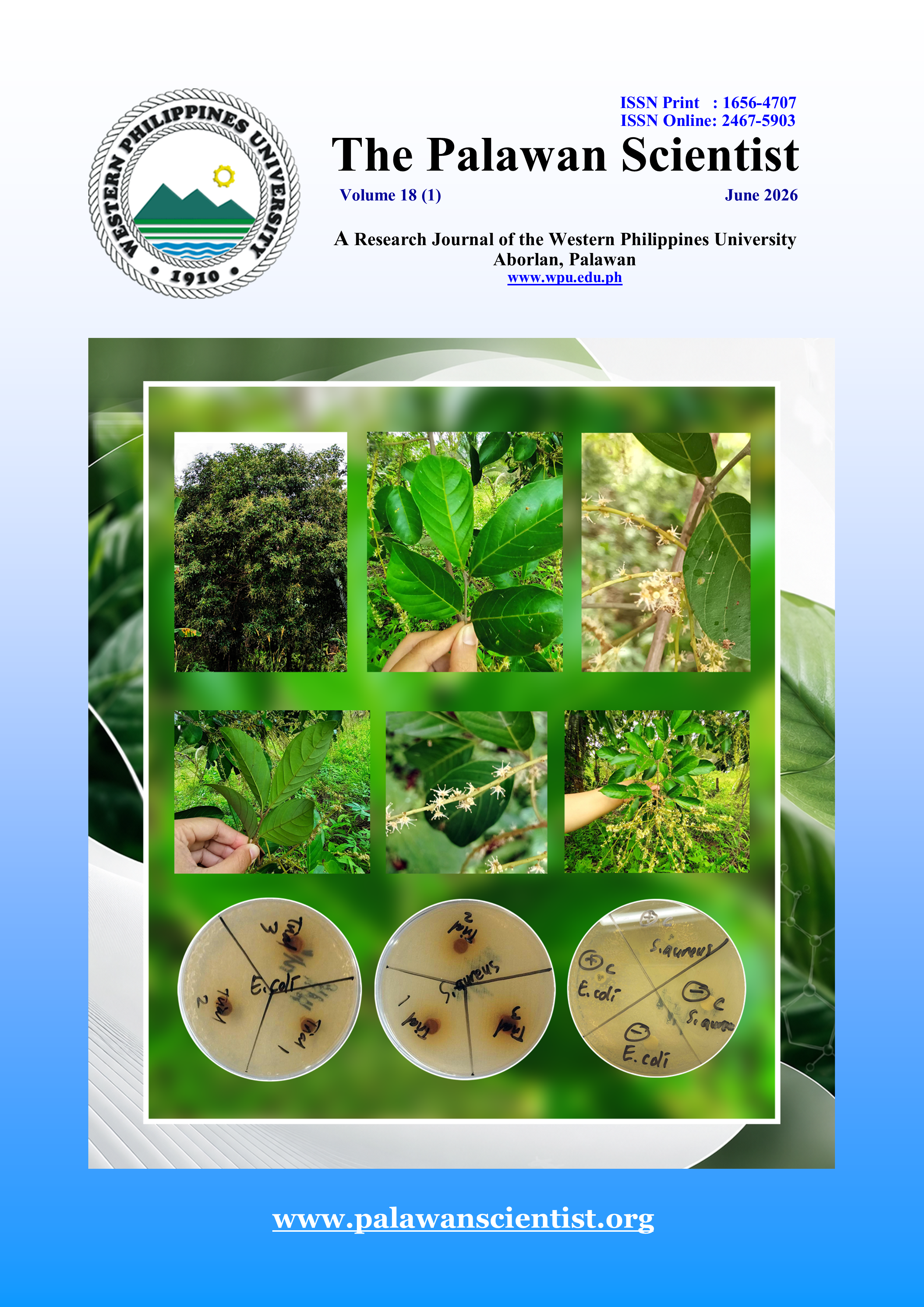
Endolichenic fungi (ELF), filamentous fungi that live asymptomatically within the lichen thalli, hold promise for combating ESKAPE bacteria — Enterococcus faecalis Schleifer and Kilpper-Bälz 1984, Staphylococcus aureus Rosenbach 1884, Klebsiella pneumoniae Trevisan 1887, Acinetobacter baumannii Bouvet and Grimont 1986, Pseudomonas aeruginosa Migula, and Enterobacter aerogenes Hormaeche and Edwards 1960 (current name: Klebsiella aerogenes Tindall et al. 2017). Twelve ELF from Ramalina were cultured in rice medium and potato dextrose broth (PDB), extracted with ethyl acetate, and assessed for antibacterial activity using a disc diffusion assay against ESKAPE bacterial pathogens. Specifically, 40 μL of 10 mg/mL crude extracts were impregnated onto each disc and placed on 15 mL Mueller-Hinton agar plates previously swabbed with 1 mL of bacterial suspension equivalent to a 0.5 McFarland standard. Crude culture extracts of Xylaria badia Pat. grown in PDB showed promising inhibitory activities against E. faecalis and S. aureus, with zones of inhibition (ZOI) of 18.17 mm and 21.70 mm, respectively. In addition, crude culture extracts of Nemania bipapillata (Berk. & M.A.Curtis) Pouzar grown in rice medium showed weak inhibition against A. baumannii (10.23 mm ZOI). These findings support the potential of endolichenic fungi, particularly X. badia and N. bipapillata, as sources of secondary metabolites active against ESKAPE bacterial pathogens.
How to Cite
Downloads
##plugins.themes.bootstrap3.article.details##
bioprospecting, disc diffusion assay, fruticose lichen, Philippines
da Silva AS, Paiva PMG, Santos FHGD, Pimentel CSDL, Falcão EPS, Araújo HDAD, Navarro DMDAF, Martins MCB, Buril MDLL, Napoleão TH, and others. 2021. Insecticidal activity of the ether extract from the lichen Ramalina complanata and an isolated metabolite (divaricatic acid) against Sitophilus zeamais (Coleoptera, Curculionidae). Biocatalysis and Agricultural Biotechnology. 35:102049. https://doi.org/10.1016/j.bcab.2021.102049
dela Cruz TE, Wagner S, Schulz B. 2006. Physiological responses of marine Dendryphiella species from different geographical locations. Mycological Progress. 5(2):108–119. https://doi.org/10.1007/s11557-006-0504-y
Frisvad JC. 2012. Media and growth conditions for induction of secondary metabolite production. In: Fungal Secondary Metabolism: Methods and Protocols. Humana Press. 944:47–58. https://doi.org/10.1007/978-1-62703-122-6_3
Galinato MGM, Bungihan ME, Santiago KAA, Sangvichien E, dela Cruz TEE. 2021. Antioxidant activities of fungi inhabiting Ramalina peruviana: Insights on the role of endolichenic fungi in the lichen symbiosis. Current Research in Environmental & Applied Mycology. 11(1):119–136. https://doi.org/10.5943/cream/11/1/10
Gazo SMT, Santiago KAA, Tjitrosoedirjo SS, dela Cruz TEE. 2019. Antimicrobial and herbicidal activities of the fruticose lichen Ramalina from Guimaras Island, Philippines. Biotropia. 26(1):23-32. https://doi.org/10.11598/btb.2019.26.1.836
Guevara BQ. 2005. A guidebook to plant screening: phytochemical and biological. Manila, Philippines: University of Santo Tomas Publishing House. pp. 23–62.
Kirk PM, Cannon PF, Minter DW, Stalpers JA, editors. 2010. Dictionary of the Fungi. 10th edition. United Kingdom: CABI.
Koopaie M, Karimi H, Sohrabi M, Norouzi H. 2023. Cytotoxic, anti-proliferative, and apoptotic evaluation of Ramalina sinensis (Ascomycota, Lecanoromycetes), lichenized fungus on oral squamous cell carcinoma cell line: in-vitro study. BMC Complementary Medicine and Therapies. 23(1):296. https://doi.org/10.1186/s12906-023-04118-1
Kumarihamy M, Ferreira D, Croom EM, Sahu R, Tekwani BL, Duke SO, Khan S, Techen N, Nanayakkara NPD. 2019. Antiplasmodial and cytotoxic cytochalasins from an endophytic fungus, Nemania sp. UM10M isolated from a diseased Torreya taxifolia leaf. Molecules. 24(4):777. https://doi.org/10.3390/molecules24040777
Lee JS, Ko KS, Jung HS. 2000. Phylogenetic analysis of Xylaria based on nuclear ribosomal ITS1-5.8S-ITS2 sequences. FEMS Microbiology Letters. 187(1):89–93. https://doi.org/10.1111/j.1574-6968.2000.tb09142.x
Moreira ASN, Braz-Filho R, Mussi-Dias V, Vieira IJC. 2015. Chemistry and biological activity of Ramalina lichenized fungi. Molecules. 20(5):8952-8987. https://doi.org/10.3390/molecules20058952
Orachaipunlap K, Suwannasai N, Whalley AJS, Phosri C, Sihanonth P. 2016. Biological activities of endophytic Xylaria. Biological and Chemical Research. 3:200–208.
Pan XY, Song ZK, Qu Z, Liu TD, Ma HX. 2022. Three new Xylaria species (Xylariaceae, Xylariales) on fallen leaves from Hainan Tropical Rainforest National Park. MycoKeys. 86:47–63. https://doi.org/10.3897/mycokeys.86.71623
Paranagama PA, Wijeratne EMK, Burns AM, Marron MT, Gunatilaka MK, Arnold AE, Gunatilaka AAL. 2007. Heptaketides from Corynespora sp. inhabiting the cavern beard lichen, Usnea cavernosa: First report of metabolites of an endolichenic fungus. Journal of Natural Products. 70(11):1700–1705. https://doi.org/10.1021/np070466w
Pi YH, Long SH, Wu YP, Liu LL, Lin Y, Long QD, Kang JC, Kang YQ, Chang CR, Shen XC, and others. 2021. A taxonomic study of Nemania from China, with six new species. MycoKeys. 83:39–67. https://doi.org/10.3897/mycokeys.83.69906
Rajendran S, Robertson LP, Kosgahakumbura L, Fernando C, Göransson U, Wang H, Hettiarachchi C, Gunasekera S. 2023. Antibacterial eremophilane sesquiterpenoids from Xylaria feejeensis, an endophytic fungi of the medicinal plant Geophila repens. Fitoterapia. 167:105496. https://doi.org/10.1016/j.fitote.2023.105496
Sánchez-Ortiz BL, Sánchez-Fernández RE, Duarte G, Lappe-Oliveras P, Macías-Rubalcava ML. 2016. Antifungal, anti-oomycete and phytotoxic effects of volatile organic compounds from the endophytic fungus Xylaria sp. Strain PB3f3 isolated from Haematoxylon brasiletto. Journal of Applied Microbiology. 120(5):1313–1325. https://doi.org/10.1111/jam.13101
Santiago KAA, dela Cruz TEE, Ting ASY. 2021a. Diversity and bioactivity of endolichenic fungi in Usnea lichens of the Philippines. Czech Mycology. 73(1):1–19. https://doi.org/10.33585/cmy.73101
Santiago KAA, Edrada-Ebel R, dela Cruz TEE, Cheow YL, Ting ASY. 2021b. Biodiscovery of Potential Antibacterial Diagnostic Metabolites from the Endolichenic Fungus Xylaria venustula Using LC–MS-Based Metabolomics. Biology. 10(3). https://doi.org/10.3390/biology10030191
Santiago KAA, dela Cruz TEE, Ting ASY. 2022. Endolichenic fungi from common Usnea lichens found in a montane forest in Malaysia: A study on diversity and bioactivity profiling. Asian Journal of Mycology. 5(2):18–37. https://doi.org/10.5943/ajom/5/2/3
Suryelita S, Riga R, Etika SB, Ulfah M, Artasasta MA. 2021. Antibacterial screening of endophytic fungus Xylaria sp. derived from Andrographis paniculata (Sambiloto). Open Access Macedonian Journal of Medical Sciences. 9(A):971-975. https://doi.org/10.3889/oamjms.2021.7475
Tan M, Castro S, Oliva PM, Yap RP, Nakayama A, Magpantay H, dela Cruz TEE. 2020. Biodiscovery of antibacterial constituents from the endolichenic fungi isolated from Parmotrema rampoddense. 3 Biotech. 10(5):212. https://doi.org/10.1007/s13205-020-02213-5
Tang AMC, Jeewon R, Hyde KD. 2007. Phylogenetic relationships of Nemania plumbea sp. Nov. And related taxa based on ribosomal ITS and RPB2 sequences. Mycological Research. 111(4):392–402. https://doi.org/10.1016/j.mycres.2007.01.009
Tibpromma S, Zhang L, Karunarathna SC, Du TY, Phukhamsakda C, Rachakunta M, Suwannarach N, Xu J, Mortimer PE, Wang YH. 2021. Volatile constituents of endophytic fungi isolated from Aquilaria sinensis with descriptions of two new species of Nemania. Life. 11(4):363. https://doi.org/10.3390/life11040363
Vandermolen KM, Raja HA, El-Elimat T, Oberlies NH. 2013. Evaluation of culture media for the production of secondary metabolites in a natural products screening program. AMB Express. 3(1):71. https://doi.org/10.1186/2191-0855-3-71

This work is licensed under a Creative Commons Attribution-NonCommercial 4.0 International License.