
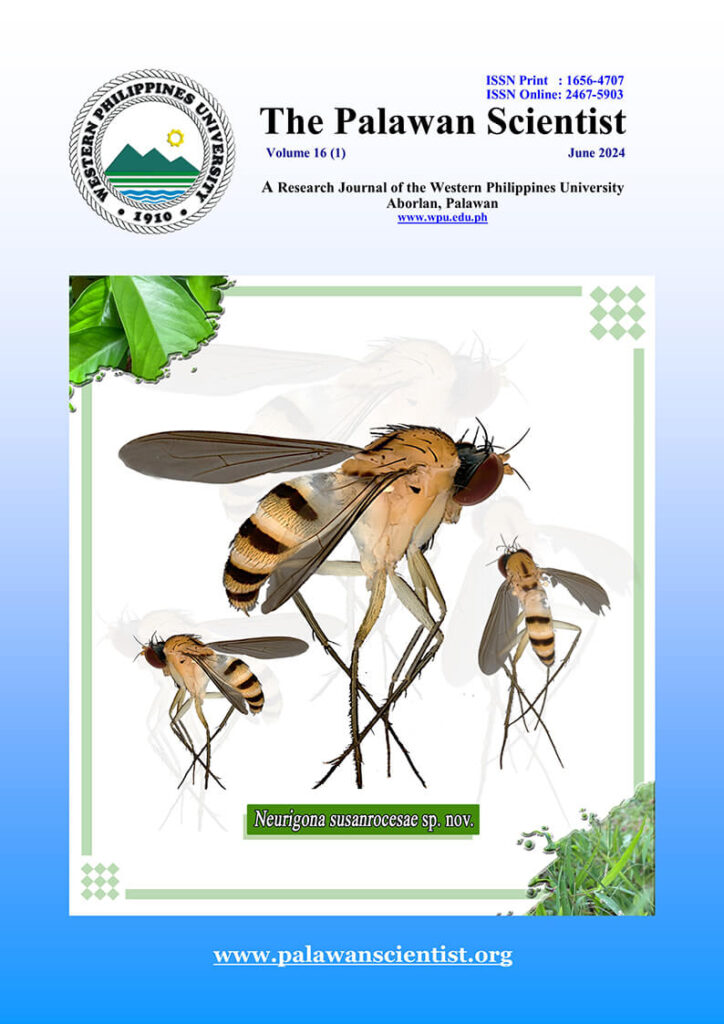
Neurigona susanrocesae, the first Neurigona species from the Philippines
##plugins.themes.bootstrap3.article.sidebar##
##plugins.themes.bootstrap3.article.main##

Abstract
The first species of the genus Neurigona is described from the Philippines. The diagnosis, description and molecular data based on the partial DNA sequence of mitochondrial cytochrome oxidase subunit I gene were documented. The Neurigona species exhibits distinct characteristics, including a sub-apical dorsal stylus resembling an arista, a peduncle on the seventh abdominal segment, a flat dorsal postcranium, elongated legs devoid of prominent setae or bristles, and a distinctive rectangular bend in wing vein M. Based on the DNA sequence analysis, the unknown species is 90.06% similar to Cyrtona sp. and Neurigona zhejiangensis. However, 10% of its DNA sequences are significantly variable making it a totally different species. The specimen was verified by a dipterist as a species belonging to Genus Neurigona under Family Dolichopodidae. These flies are recognized for their lengthy legs and sizable yellow bodies. The species was named as N. susanrocesae as a tribute to the late Susan Roces, the "Queen of Philippine Movies”.
How to Cite
Downloads
##plugins.themes.bootstrap3.article.details##
Barrett RD and Hebert PD. 2005. Identifying spiders through DNA barcodes. Canadian Journal of Zoology, 83(3): 481-491. https://doi.org/10.1139/z05-024
Bickel DJ and Lian-Meng W. 1996. Dolichopodidae (Diptera) from southwestern China - Part I. Oriental Insects, 30(1): 251-277. https://doi.org/10.1080/00305316.1996.10433845
Bickel DJ. 2009. Dolichopodidae (Long-legged Flies). In: Brown BV, Borkent A, Cumming JM, Wood DM, Woodley NE and Zumbado MA (eds). Manual of Central American Diptera, Vol. 1, NRC Research Press, Ottawa, pp. 671–694.
Blaxter M, Mann J, Chapman T, Whitton C, Floyd R and Abebe E. 2005. Defining operational taxonomic units using DNA barcode data. Philosophical Transactions of the Royal Society B: Biological Sciences, 360(1462): 1935-1943. https://doi.org/10.1098/rstb.2005.1725
Brown BV. 2005. Malaise trap catches and the crisis in Neotropical dipterology. American Entomologist, 51(3): 180-183. https://doi.org/10.1093/ae/51.3.180
Coulibaly B. 1993. Dolichopodidae (Diptera) in the biological control of certain insects harmful to forest ecosystems Dolichopodidae (Diptera) in the biological control of certain insects harmful to forest ecosystems. Insect Science and its Applications, 14(1): 85-87.
Grichanov I, Chursina M and Wang M. 2021. Detection of biodiversity local centers and gradients of change of Dolichopodidae (Diptera) in East Asia. Journal of Insect Biodiversity, 28(1): 13-34. https://doi.org/10.12976/jib/2021.28.1.2
Grichanov I. 2023. A Checklist of Species of the Family Dolichopodidae (Diptera) of the World Arranged by Alphabetic List of Generic Names. http://grichanov.aiq.ru/Genera3.htm. Accessed on 17 April 2023.
Grootaert P and Meuffels HJG. 2004. Insecta: Diptera, Dolichopodidae. In: Yong HS and Yule CM (eds). In: Freshwater Invertebrates of the Malaysian Region. Academy of Sciences Malaysia and Monash University, Kuala Lumpur, Malaysia, pp. 810-817.
Grootaert P and Foo MS. 2019. The springtail catchers of the genus Neurigona (Insecta, Diptera, Dolichopodidae) in the primary forest of Bukit Timah Nature Reserve, Singapore. Gardens’ Bulletin Singapore, 71(Suppl. 1): 369-379. https://doi.org/10.26492/gbs71(suppl.1).2019-15
Heaney LR. 2000. Dynamic disequilibrium: a long‐term, large‐scale perspective on the equilibrium model of island biogeography. Global Ecology and Biogeography, 9(1): 59-74. https://doi.org/10.1046/j.1365-2699.2000.00163.x
Jose RP, Deocaris CC, Andres MI and Alinsug MV. 2022. Chrysosoma nellyae (Diptera: Dolichopodidae), a New Fly Species Discovered from Bohol Island, Philippines. Journal of the Entomological Research Society, 24(3): 339-345. https://doi.org/10.51963/jers.v24i3.2272
Kumar S, Stecher G, Li M, Knyaz C and Tamura K. 2018. MEGA X: Molecular Evolutionary Genetics Analysis across computing platforms. Molecular Biology and Evolution, 35(6): 1547-1549. https://doi.org/10.1093%2Fmolbev%2Fmsy096
Meier R, Wong W, Srivathsan A and Foo M. 2016. $1 DNA barcodes for reconstructing complex phenomes and finding rare species in specimen-rich samples. Cladistics, 32(1): 100-110. https://doi.org/10.1111/cla.12115
Parent O. 1935. Diptères Dolichopodides conservés au Muséum des États Malais Confédérés. Annals and Magazine of Natural History, 15(87): 354-369.
Oosterbroek P. 1998. The Families of Diptera of the Malay Archipelago. Brill Press, Leiden (The Netherlands). 227pp.
Ramos KP, Meier R, Nuneza O and Grootaert P. 2018. Two new species of mangrove Dolichopodidae from Bohol Island in the Philippines (Insecta: Diptera) and a checklist of the Dolichopodidae of the Philippines. The Raffles Bulletin of Zoology, 66: 268-276.
Ramos KP and Grootaert P. 2018. Description of a New Mangrove Hercostomus Loew (Diptera: Dolichopodidae: Dolichopodinae) from Bohol, Philippines. Tropical Natural History, 18(1): 24-31.
Saitou N and Nei M. 1987. The neighbor-joining method: a new method for reconstructing phylogenetic trees. Molecular Biology and Evolution, 4(4): 406-425. https://doi.org/10.1093/oxfordjournals.molbev.a040454
Srivathsan A and Meier R. 2012. On the inappropriate use of Kimura‐2‐parameter (K2P) divergences in the DNA‐barcoding literature. Cladistics, 28(1): 190-194. https://doi.org/10.1111/j.1096-0031.2011.00370.x
Stork NE. 1996. Measuring global biodiversity and its decline. In: Reaka-Kudla ML, Wilson DE and Wilson EO (eds). Biodiversity II: Understanding and Protecting our Biological Resources. Joseph Henry Press, pp. 41-68.
Tamura K and Nei M. 1993. Estimation of the number of nucleotide substitutions in the control region of mitochondrial DNA in humans and chimpanzees. Molecular Biology and Evolution, 10(3): 512-526. https://doi.org/10.1093/oxfordjournals.molbev.a040023
Tamura K, Nei M and Kumar S. 2004. Prospects for inferring very large phylogenies by using the neighbor-joining method. Proceedings of the National Academy of Sciences (USA), 101(30): 11030-11035. https://doi.org/10.1073/pnas.0404206101
Wang M, Evenhuis NL, Ji Y, Yang D and Zhang L. 2022. Negrobovus, a new genus from the Philippines (Diptera: Dolichopodidae: Sympycninae). In Proceedings of the Russian Entomological Society, 92: 37-41. https://doi.org/10.47640/1605-7678_2021_92_37
Wong WH, Tay YC, Puniamoorthy J, Balke M, Cranston PS and Meier R. 2014. ‘Direct PCR’optimization yields a rapid, cost‐effective, nondestructive and efficient method for obtaining DNA barcodes without DNA extraction. Molecular Ecology Resources, 14(6): 1271-1280. https://doi.org/10.1111/1755-0998.12275
Yang D, Zhu YJ, Wang MQ and Zhang LL. 2006. World Catalog of Dolichopodidae (Insecta: Diptera). Agricultural University Press, Beijing, China. 704pp.
Zhang J, Kobert K, Flouri T and Stamatakis A. 2014. PEAR: a fast and accurate Illumina Paired-End read merger. Bioinformatics, 30(5): 614-620. https://doi.org/10.1093/bioinformatics/btt593

This work is licensed under a Creative Commons Attribution-NonCommercial 4.0 International License.