
Environmental distribution and polymer characterization of microplastics in the Miagao Estuary, Iloilo, Philippines
##plugins.themes.bootstrap3.article.sidebar##
##plugins.themes.bootstrap3.article.main##

Abstract
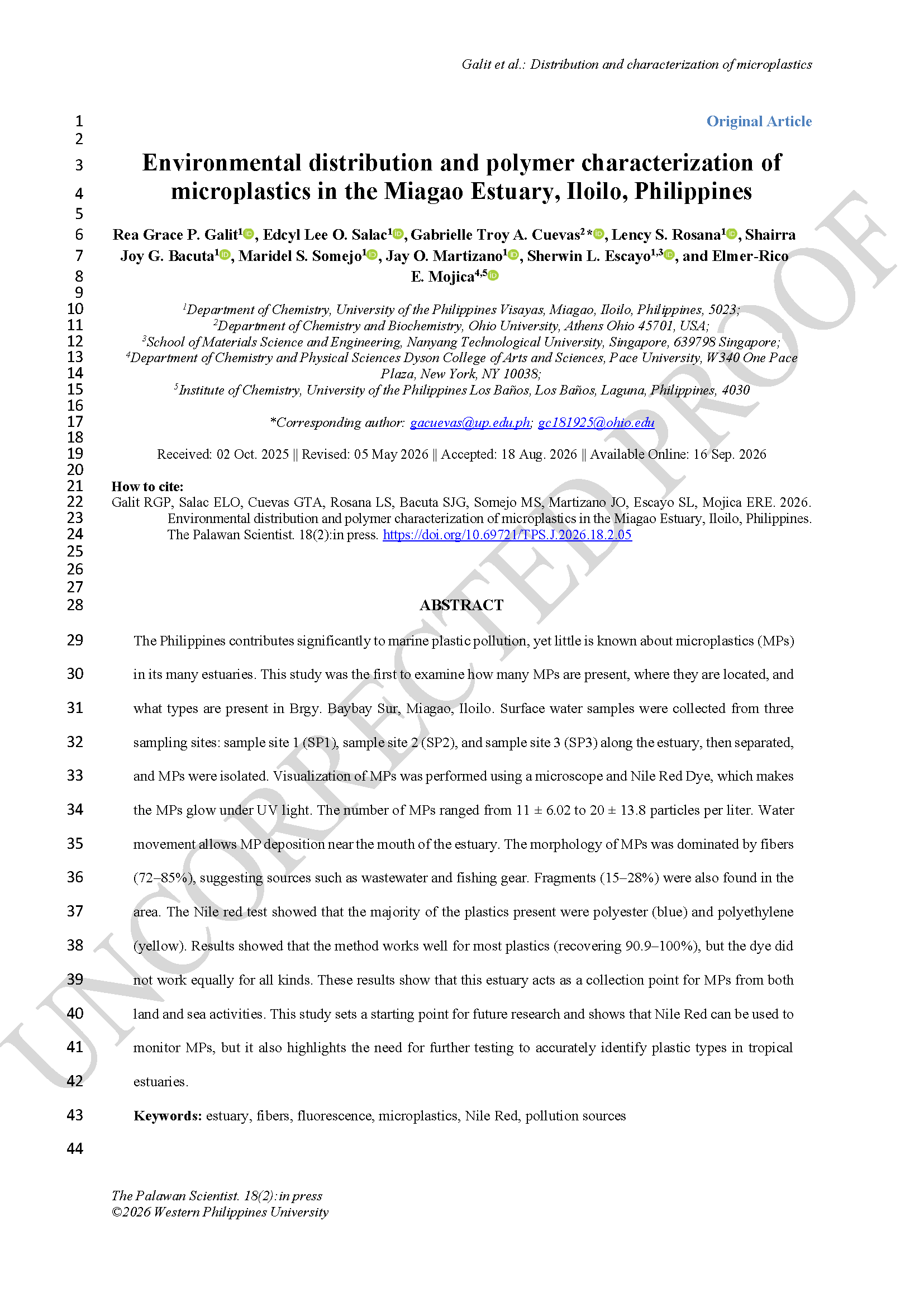
The Philippines contributes significantly to marine plastic pollution, yet little is known about microplastics (MPs) in its many estuaries. This study was the first to examine how many MPs are present, where they are located, and what types are present in Brgy. Baybay Sur, Miagao, Iloilo. Surface water samples were collected from three sampling sites: sample site 1 (SP1), sample site 2 (SP2), and sample site 3 (SP3) along the estuary, then separated, and MPs were isolated. Visualization of MPs was performed using a microscope and Nile Red Dye, which makes the MPs glow under UV light. The number of MPs ranged from 11 ± 6.02 to 20 ± 13.8 particles per liter. Water movement allows MP deposition near the mouth of the estuary. The morphology of MPs was dominated by fibers (72–85%), suggesting sources such as wastewater and fishing gear. Fragments (15–28%) were also found in the area. The Nile red test showed that the majority of the plastics present were polyester (blue) and polyethylene (yellow). Results showed that the method works well for most plastics (recovering 90.9–100%), but the dye did not work equally for all kinds. These results show that this estuary acts as a collection point for MPs from both land and sea activities. This study sets a starting point for future research and shows that Nile Red can be used to monitor MPs, but it also highlights the need for further testing to accurately identify plastic types in tropical estuaries.
How to Cite
Downloads
##plugins.themes.bootstrap3.article.details##
estuary, fibers, fluorescence, microplastics, Nile Red, pollution sources
Arcadio CGLA, Navarro CKP, Similatan KM, Inocente SAT, Ancla SMB, Banda MHT, Capangpangan RY, Torres AG, Bacosa HP. 2023. Microplastics in surface water of Laguna de Bay: First documented evidence on the largest lake in the Philippines. Environmental Science and Pollution Research. 30(11):29824–29833. https://doi.org/10.1007/s11356-022-24261-5
Barboza LGA, Dick Vethaak A, Lavorante BRBO, Lundebye A-K, Guilhermino L. 2018. Marine microplastic debris: An emerging issue for food security, food safety and human health. Marine Pollution Bulletin. 133:336–348. https://doi.org/10.1016/j.marpolbul.2018.05.047
Barnes DKA, Galgani F, Thompson RC, Barlaz M. 2009. Accumulation and fragmentation of plastic debris in global environments. Philosophical Transactions of the Royal Society of London. Series B, Biological Sciences. 364(1526):1985–1998 https://doi.org/10.1098/rstb.2008.0205
Borrelle SB, Ringma J, Law KL, Monnahan CC, Lebreton L, McGivern A, Murphy E, Jambeck J, Leonard GH, Hilleary MA. 2020. Predicted growth in plastic waste exceeds efforts to mitigate plastic pollution. Science. 369(6510):1515-1518. https://doi.org/10.1126/science.aba3656
Browne MA, Galloway TS, Thompson RC. 2010. Spatial patterns of plastic debris along estuarine shorelines. Environmental Science and Technology. 44(9):3404–3409. https://doi.org/10.1021/es903784e
Bucol LA, Romano EF, Cabcaban SM, Siplon LMD, Madrid GC, Bucol AA, Polidoro B. 2020. Microplastics in marine sediments and rabbitfish (Siganus fuscescens) from selected coastal areas of Negros Oriental, Philippines. Marine Pollution Bulletin. 150:110685. https://doi.org/10.1016/j.marpolbul.2019.110685
Cabansag JBP, Olimberio RB, Villanobos ZMT. 2021a. Microplastics in some fish species and their environs in Eastern Visayas, Philippines. Marine Pollution Bulletin. 167:112312. https://doi.org/10.1016/j.marpolbul.2021.112312
Cabansag JBP, Olimberio RB, Villanobos ZMT. 2021b. Microplastics in some fish species and their environs in Eastern Visayas, Philippines. Marine Pollution Bulletin. 167:112312. https://doi.org/10.1016/j.marpolbul.2021.112312
Carballeira Braña CB, Cerbule K, Senff P, Stolz IK. 2021. Towards environmental sustainability in marine finfish aquaculture. Frontiers in Marine Science. 8: 666662. https://doi.org/10.3389/fmars.2021.666662
Caruso G. 2019. Microplastics as vectors of contaminants. Marine Pollution Bulletin. 146(2):921–924. https://doi.org/10.1016/j.marpolbul.2019.07.052
Cole M, Lindeque P, Halsband C, Galloway TS. 2011. Microplastics as contaminants in the marine environment: A review. Marine Pollution Bulletin. 62(12):2588–2597. https://doi.org/10.1016/j.marpolbul.2011.09.025
Egessa R, Nankabirwa A, Ocaya H, Pabire WG. 2020. Microplastic pollution in surface water of Lake Victoria. Science of the Total Environment. 741:140201. https://doi.org/10.1016/j.scitotenv.2020.140201
Elmer-Dixon M, Fawcett L, Hinderliter B, Maurer-Jones M. 2022. Could superficial chiral nanostructures be the reason polyethylene yellows as it ages? ACS Applied Polymer Materials Journal. 4(9):6458–6465. https://doi.org/10.1021/acsapm.2c00877
Erni-Cassola G, Gibson MI, Thompson RC, Christie-Oleza JA. 2017. Lost, but found with Nile Red: A novel method for detecting and quantifying small microplastics (1 mm to 20 μm) in environmental samples. Environmental Science and Technology. 51(23):13641–13648. https://doi.org/10.1021/acs.est.7b04512
Froese R, Pauly D. 2025. FishBase. Siganus fuscescens (Houttuyn, 1782). World Register of Marine Species. [accessed 2025 Nov 07]. https://www.marinespecies.org/aphia.php?p=taxdetails&id=273912.
Gabriel AD, Amparado Jr. RF, Lubguban AA, Bacosa HP. 2023. Riverine microplastic pollution: Insights from Cagayan de Oro River, Philippines. International Journal of Environmental Research and Public Health. 20(12):6132. https://doi.org/10.3390/ijerph20126132
Gray AD, Wertz H, Leads RR, Weinstein JE. 2018. Microplastic in two South Carolina Estuaries: Occurrence, distribution, and composition. Marine Pollution Bulletin. 128:223–233. https://doi.org/10.1016/j.marpolbul.2018.01.030
Hansen J, Hildebrandt L, Zimmermann T, El Gareb F, Fischer EK, Pröfrock D. 2023. Quantification and characterization of microplastics in surface water samples from the Northeast Atlantic Ocean using laser direct infrared imaging. Marine Pollution Bulletin. 190:114880. https://doi.org/10.1016/j.marpolbul.2023.114880
Jambeck JR, Geyer R, Wilcox C, Siegler TR, Perryman M, Andrady A, Narayan R, Law KL. 2015. Marine pollution. Plastic waste inputs from land into the ocean. Science. 347(6223):768–771. https://doi.org/10.1126/science.1260352
Lebreton LCM, van der Zwet J, Damsteeg J-W, Slat B, Andrady A, Reisser J. 2017. River plastic emissions to the world’s oceans. Nature Communications. 8:15611. https://doi.org/10.1038/ncomms15611
Löder MGJ, Gerdts G. 2015. Methodology used for the detection and identification of microplastics—A Critical Appraisal. In: Bergmann M, Gutow L, Klages M, editors. Marine Anthropogenic Litter. Cham: Springer International Publishing. p. 201–227. https://doi.org/10.1007/978-3-319-16510-3_8
Maes T, Jessop R, Wellner N, Haupt K, Mayes AG. 2017a. A rapid-screening approach to detect and quantify microplastics based on fluorescent tagging with Nile Red. Scientific Reports. 7:44501. https://doi.org/10.1038/srep44501
Maes T, Van der Meulen MD, Devriese LI, Leslie HA, Huvet A, Frère L, Robbens J, Vethaak AD. 2017b. Microplastics baseline surveys at the water surface and in sediments of the North-East Atlantic. Frontiers in Marine Science. 4:135. https://doi.org/10.3389/fmars.2017.00135
Maslov N, Dulin V. 2020. Investigation of fluorescence spectra of various types of plastics for the purpose of sorting and further processing. Journal of Physics: Conference Series. 1677:012186. https://doi.org/10.1088/1742-6596/1677/1/012186
Meijer L, van Emmerik T, Ent R, Schmidt C, Lebreton L. 2021. More than 1000 rivers account for 80% of global riverine plastic emissions into the ocean. Science Advances. 7(18):eaaz5803. https://doi.org/10.1126/sciadv.aaz5803
Naji A, Nuri M, Vethaak AD. 2018. Microplastics contamination in molluscs from the northern part of the Persian Gulf. Environmental Pollution. 235:113–120. https://doi.org/10.1016/j.envpol.2017.12.046
Nel HA, Dalu T, Wasserman RJ. 2018. Sinks and sources: Assessing microplastic abundance in river sediment and deposit feeders in an Austral temperate urban river system. Science of Total Environment. 612:950–956. https://doi.org/10.1016/j.scitotenv.2017.08.298
Osorio ED, Tanchuling MAN, Diola MDLD. 2021. Microplastics occurrence in surface waters and sediments in five river mouths of Manila Bay. Frontiers in Environmental Science. Toxicology, Pollution and the Environment. 9. https://doi.org/10.3389/fenvs.2021.719274
Park DH, Oh SB, Hong SC. 2022. In situ fluorescent illumination of microplastics in water utilizing a combination of dye/surfactant and quenching techniques. Polymers. 14(15):3084. https://doi.org/10.3390/polym14153084
Prata JC, da Costa JP, Lopes I, Duarte AC, Rocha-Santos T. 2020. Environmental exposure to microplastics: An overview on possible human health effects. Science of Total Environment. 702:134455. https://doi.org/10.1016/j.scitotenv.2019.134455
Ray SS, Lee HK, Huyen DTT, Chen S-S, Kwon Y-N. 2022. Microplastics waste in environment: A perspective on recycling issues from PPE kits and face masks during the COVID-19 pandemic. Environmental Technology and Innovation. 26:102290. https://doi.org/10.1016/j.eti.2022.102290
Rochman CM, Hoh E, Kurobe T, Teh SJ. 2013. Ingested plastic transfers hazardous chemicals to fish and induces hepatic stress. Scientific Reports. 3:3263. https://doi.org/10.1038/srep03263
Rodrigues MO, Abrantes N, Gonçalves FJM, Nogueira H, Marques JC, Gonçalves AMM. 2018. Spatial and temporal distribution of microplastics in water and sediments of a freshwater system (Antuã River, Portugal). Science of Total Environment. 633:1549–1559. https://doi.org/10.1016/j.scitotenv.2018.03.233
Rumin J, Bonnefond H, Saint-Jean B, Rouxel C, Sciandra A, Bernard O, Cadoret J-P, Bougaran G. 2015. The use of fluorescent Nile red and BODIPY for lipid measurement in microalgae. Biotechnology for Biofuels and Bioproducts. 8:42. https://doi.org/10.1186/s13068-015-0220-4
Santonicola S, Volgare M, Pace E, Mercogliano R, Cocca M, Colavita G. 2023. Research and characterization of fibrous microplastics and natural microfibers in pelagic and benthic fish species of commercial interest. Italian Journal of Food Science. 12(1). https://doi.org/10.4081/ijfs.2023.11032
Santonicola S, Volgare M, Rossi F, Castaldo R, Cocca M, Colavita G. 2024. Detection of fibrous microplastics and natural microfibers in fish species (Engraulis encrasicolus, Mullus barbatus and Merluccius merluccius) for human consumption from the Tyrrhenian Sea. Chemosphere. 363:142778. https://doi.org/10.1016/j.chemosphere.2024.142778
Sargadillos R, Endoma Jr L, Nillos MG, Yap EE. 2025. Nile red staining technique for microplastics detection in sardines (Sardinella lemuru) using fluorescence stereomicroscopy. Philippine Journal of Science. 154:475–488.
Silva DM, Almeida CMR, Guardiola FA, Pereira R, Rodrigues SM, Ramos S. 2024. Uncovering microplastics contamination in canned seafood. Food Chemistry. 448:139049. https://doi.org/10.1016/j.foodchem.2024.139049
Smith M, Love DC, Rochman CM, Neff RA. 2018. Microplastics in seafood and the implications for human health. Current Environmental Health Reports. 5(3):375–386. https://doi.org/10.1007/s40572-018-0206-z
Song YK, Hong SH, Jang M, Han GM, Rani M, Lee J, Shim WJ. 2015. A comparison of microscopic and spectroscopic identification methods for analysis of microplastics in environmental samples. Marine Pollution Bulletin. 93(1-2):202–209. https://doi.org/10.1016/j.marpolbul.2015.01.015
Suaria G, Perold V, Lee JR, Lebouard F, Aliani S, Ryan PG. 2020. Floating macro- and microplastics around the Southern Ocean: Results from the Antarctic Circumnavigation Expedition. Environment International. 136:105494. https://doi.org/10.1016/j.envint.2020.105494
Sudheshna AA, Srivastava M, Prakash C. 2022. Characterization of microfibers emission from textile washing from a domestic environment. Science of Total Environment. 852:158511. https://doi.org/10.1016/j.scitotenv.2022.158511
Tirkey A, Upadhyay LSB. 2021. Microplastics: An overview on separation, identification and characterization of microplastics. Marine Pollution Bulletin. 170:112604. https://doi.org/10.1016/j.marpolbul.2021.112604
WoRMS Editorial Board. 2026. World Register of Marine Species. [accesed 2025 Nov 27]. https://doi.org/10.14284/170
Wright SL, Thompson RC, Galloway TS. 2013. The physical impacts of microplastics on marine organisms: A review. Environmental Pollution. 178:483–492. https://doi.org/10.1016/j.envpol.2013.02.031
Yonkos LT, Friedel EA, Perez-Reyes AC, Ghosal S, Arthur CD. 2014. Microplastics in four estuarine rivers in the Chesapeake Bay, U.S.A. Environmental Science and Technology. 48(24):14195–14202. https://doi.org/10.1021/es5036317

This work is licensed under a Creative Commons Attribution-NonCommercial 4.0 International License.