
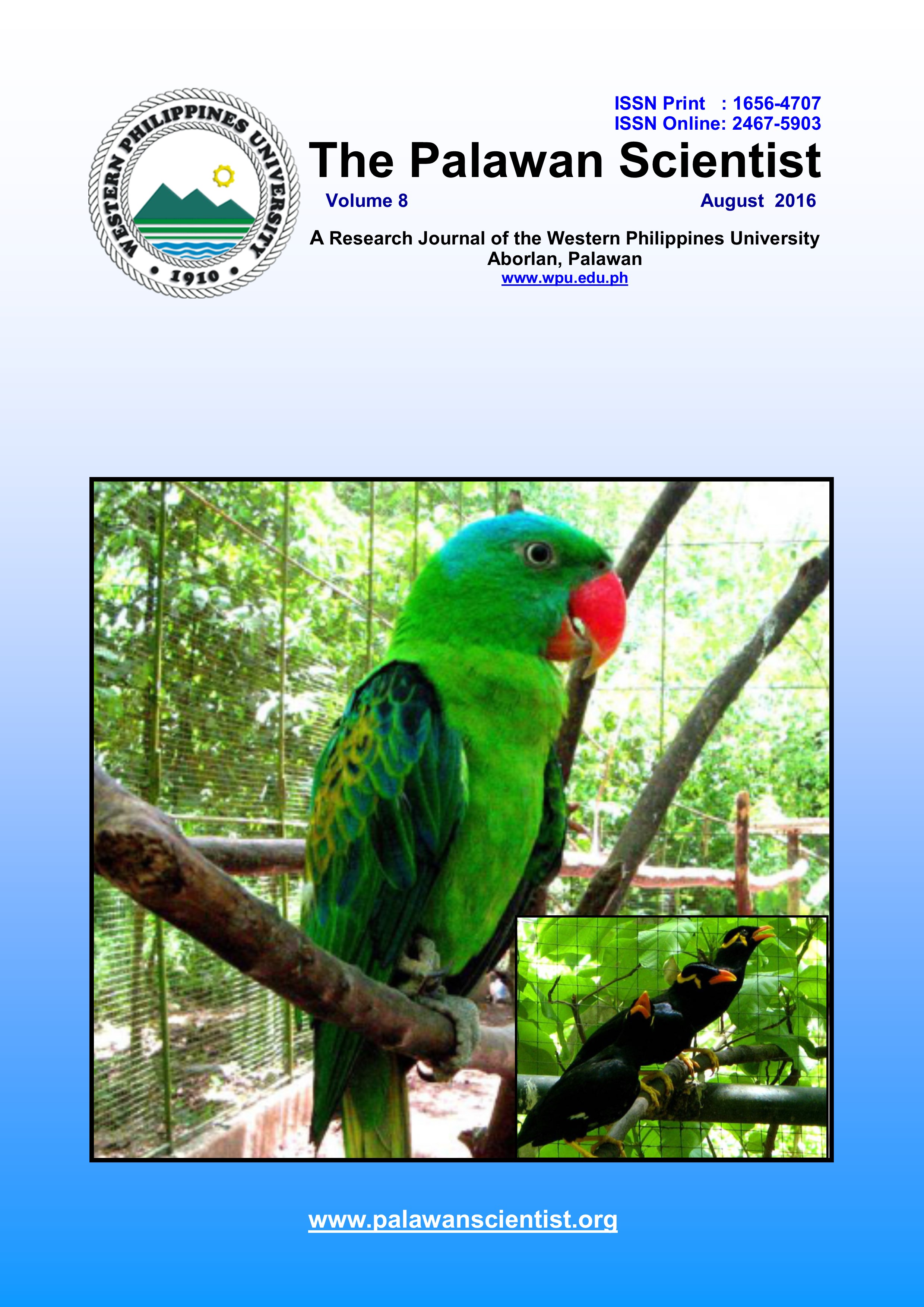
Georeferencing and characterization of nesting trees of commonly traded wild birds (Blue-naped Parrot Tanygnathus lucionensis and Hill Myna Gracula religiosa) in Talakaigan Watershed Aborlan, Palawan, Philippines
##plugins.themes.bootstrap3.article.sidebar##
##plugins.themes.bootstrap3.article.main##
Abstract
Forest degradation endangers the survival of nesting trees in the wild. Despite this threat, the nesting trees that support the commonly traded birds in Talakaigan Forest are not well documented. Hence, the study was conducted to provide information on the characteristics, species composition and geographical distribution of nesting trees. The study was participated by the indigenous Tagbanua bird poachers in the area. Preliminary information was obtained using key informant interview and focused group discussion. Appropriate parabiology training was conducted to equip the participants with practical skills needed in the data gathering. The study unfolded that there were only two species of birds commonly poached in the watershed, the Tanygnathus lucionensis and Gracula religiosa. These birds nest only on four species of trees which typically towers above the canopy layer. Remarkably, more than 60% of the recorded nesting trees belong to a single species of tree, the Koompassia excelsa. The GIS analysis unveiled that most nesting trees were located in the interior part of the forest. The skill needed to venture into the jungle highlights the role of Tagbanua Tribesmen in the poaching activity in the area. The study recommends an education campaign, enforcement of relevant environmental laws as well as conservation activities focusing on both the nest trees and the poached bird species to be implemented in the area.
How to Cite
Downloads
##plugins.themes.bootstrap3.article.details##
georeferencing, avifauna, poaching, nesting tree
Birdlife International. 2012. Tanygnathus lucionensis. The IUCN Red List of Threatened Species. Version 2014.3. http://www.iucnredlist.org. Accessed on 15 February 2015.
Carandang MG. 1996. Forest biometry syllabus. Department of Forest Resources Management. College of Forestry, University of the Philippines, Los Baños, Laguna Philippines.
Convention on International Trade of Endangered Species of Fauna and Flora.2013. CITES appendices. http://www.cites.org/eng/app/appendices.php. Downloaded on 10 July 2013.
Cruz RM, Van Den Beukel DV, Widmann IL, Schoppe S and Widmann P. 2007. Wildlife trade in SouthernPalawan, Philippines. Banwa: The Multidisciplinary Journal of UP Mindanao, 4(1):12-26.
Kennedy RSK, Gonzalez PC, Dickinson EC, Miranda Jr HC, and Fisher TH. 2000. A guide to the birds of the Philippines. Oxford University Press Inc., New York, USA. 369pp.
Mallari NAD, Tabaransa JrBR and Crosby MJ. 2001. Key conservation sites in the Philippines: a Haribon Foundation and Birdlife International Directory of Important Bird Areas. Bookmark. Makati City. 485pp.
Mallari NAD, Collar NJ, Lee DC, Mc Gowan PJK, Wilkinson R and Marsden SJ. 2011. Population densities of understorey birds across a habitat gradient in Palawan, Philippines: implications for conservation. Fauna and Flora International. Oryx, 45(2):234-242.
MDNR (Maryland Department of Natural Resources). 2013. How to Measure a Tree. http://www.dnr.state.md.us/forests/kids/bigtrees.asp. Accessed on 14 June 2013.
Ong PS, Afuang LE and Rosell-Ambal RG. (eds.) 2002. Philippine biodiversity conservation priorities: a second iteration of the national biodiversity strategy and action plan. Department of Environment and Natural Resources-Protected Areas and Wildlife Bureau, Conservation International Philippines, Biodiversity Conservation Program University of the Philippines Center for Integrative and Development Studies, and Foundation for the Philippine Environment, Quezon City, Philippines.113pp.
Sopsop LB and Buot Jr IE. 2011. Human forest interaction in Aborlan guba system, Palawan Island, Philippines: Implications for conservation and management. Asia Life Sciences: The Asian International Journal of Life Sciences, 20(1):155-173.
Widmann P. 1998. A Guide to the ecosystems of Palawan, Philippines. VISCA-GTZ Program on Applied Tropical Ecology. Times Editions. Singapore.120pp.

This work is licensed under a Creative Commons Attribution-NonCommercial 4.0 International License.