
Phytochemical screening and antibacterial properties of “duro” leaves (Nephelium ramboutan-ake (Labill.) Leenh. 1986) against Escherichia coli and Staphylococcus aureus
##plugins.themes.bootstrap3.article.sidebar##
##plugins.themes.bootstrap3.article.main##

Abstract
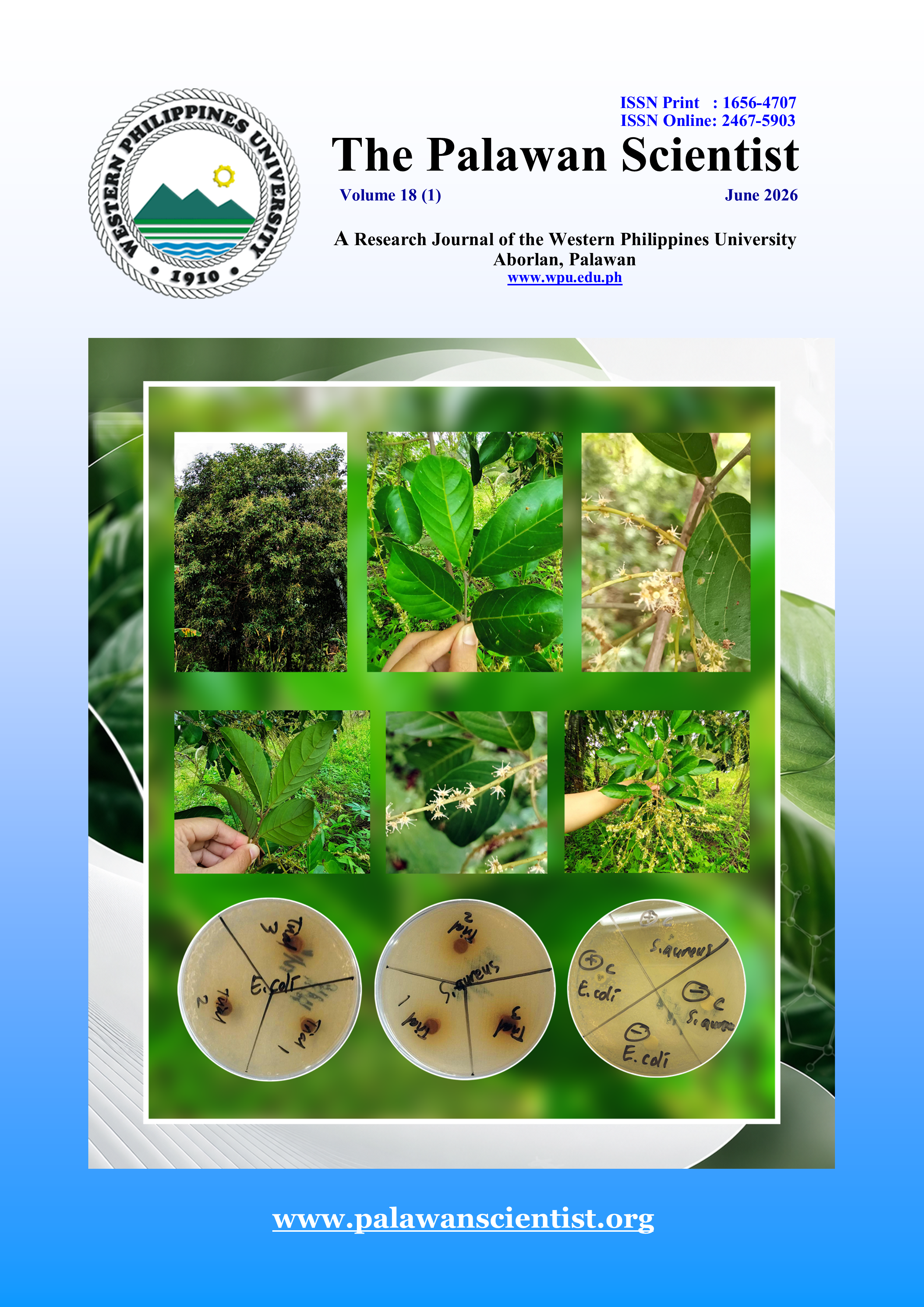
From the hinterlands of southern Palawan, Philippines, resides one of the oldest tribes in the country, the Palaw’an tribe. As mountain dwellers, they have developed unique healing practices, including the use of the “duro” Nephelium ramboutan-ake (Labill.) Leenh. 1986 plant to treat diarrhea. This study aimed to characterize the leaf morphology of “duro,” screen for the phytochemicals present, and assess the antibacterial properties of the “duro” leaf extract using the Kirby-Bauer test. Leaves of “duro” were collected from Sitio Sumurum, Brgy. Ransang, Rizal, Palawan. Samples were verified, dried, and extracted before being subjected to phytochemical screening and antibacterial susceptibility test. The morphological characteristics of “duro” leaves include smooth, green-colored, paripinnate compound leaves with an oblanceolate shape arranged oppositely. They have entire margins and pinnate venation, are attached through a petiolate, with the leaf base decurrent at the petiole, and have a mean size of 10.33 cm by 5.77 cm. Only alkaloids, flavonoids, saponins, and tannins were detected among the secondary metabolites tested, while cardiac glycosides and terpenoids were absent. The "duro" leaves extract exhibited moderate antibacterial properties against Escherichia coli (Migula, 1895) Castellani and Chalmers, 1919 and Staphylococcus aureus Rosenbach, 1884, with mean inhibition zones of 12 mm and 10.67 mm, respectively. The antibacterial properties and presence of phytochemicals suggest the therapeutic potential of "duro" leaves for treating diarrhea. This study addresses knowledge gaps regarding "duro," its medicinal use among the Palaw'an tribe, and promotes further research on indigenous plants.
How to Cite
Downloads
##plugins.themes.bootstrap3.article.details##
antibacterial susceptibility test, diarrhea treatment, Palaw’an tribe, secondary metabolites
Aktar MN, Islam MM, Raza MS, Azhar BS, Moni ZR, Rahman MM, Rahman ATMM, Tang MAK. 2022. Phytochemical characteristics and antioxidant potential of Litchi chinensis Sonn. seeds of Bangladesh. Bangladesh Journal of Agriculture, 47(1):16-26. http://dx.doi.org/10.3329/bjagri.v47i1.60590
Alemu MA, Adargie Y, Sisay W, Mengie T, Desta GT, Tessema TA, Abebe RB, Birru EM, Gebyaw ST, Ayanaw MA. 2022. Antidiarrheal effect of 80% methanol extract and fractions of the leaves of Ocimum lamiifolium in Swiss Albino Mice. Evidence-Based Complementary and Alternative Medicine. 2022(1):6838295. https://doi.org/10.1155/2022/6838295
Al-Khayri JM, Sahana GR, Nagella P, Joseph BV, Alessa FM, Al-Mssallem MQ. 2022. Flavonoids as potential anti-inflammatory molecules: A review. Molecules. 27(9):2901. https://doi.org/10.3390/molecules27092901
Bargah RK. 2015. Preliminary test of phytochemical screening of crude ethanolic and aqueous extract of Moringa pterygosperma Gaertn. Journal of Pharmacognosy and Phytochemistry. 4(1):07-09.
Bernadas Jr. CN, Peralta MD. 2017. Indigenous crops and wild plants used as food by the Palaw'an tribe in Southern Palawan, Philippines. Journal of Nature Studies. 16(1):11-17.
Chigurupati S, Vijayabalan S, Selvarajan KK, Hashish NE, Mani V, Ahmed ES, Das S. 2019. Identification of Nephelium lappaceum leaves phenolic and flavonoid component with radical scavenging, antidiabetic and antibacterial potential. Indian Journal of Traditional Knowledge. 18(2):360-365.
Cogill B. 2015. Contributions of indigenous vegetables and fruits to dietary diversity and quality. Acta Horticulturae. 1102:213-228. https://doi.org/10.17660/ActaHortic.2015.1102.27
De Las Llagas MA, Santiago LA, Ramos JDA. 2014. Antibacterial activity of crude ethanolic extract and solvent fractions of Ficus pseudopalma Blanco leaves. Asian Pacific Journal of Tropical Disease. 4(5):367–371. http://dx.doi.org/10.1016/S2222-1808(14)60589-2
Djuita NR, Hartana A, Chikmawati T, Dorly D. 2016. Characteristics and ideotype formulation of pulasan (Nephelium ramboutan-ake) fruit landrace from West Java, Indonesia. Makara Journal of Science. (21)2:69-76. https://doi.org/10.7454/mss.v21i2.7304
Everingham SE, Offord CA, Sabot ME, Moles AT. 2024. Leaf morphological traits show greater responses to changes in climate than leaf physiological traits and gas exchange variables. Ecology and Evolution. 14(3):e10941. https://doi.org/10.1002/ece3.10941
Fatisa Y. 2013. Daya antibakteri estrak kulit dan biji buah pulasan (Nephelium mutabile) Terhadap Staphylococcus aureus dan Escherichia coli secara in vitro. Jurnal Peternakan Februari. 10(1):31-38. http://dx.doi.org/10.24014/jupet.v10i1.156
Gonfa T, Teketle S, Kiros T, Yildiz F. 2020. Effect of extraction solvent on qualitative and quantitative analysis of major phyto-constituents and in-vitro antioxidant activity evaluation of Cadaba rotundifolia Forssk leaf extracts. Cogent Food & Agriculture. 6(1). https://doi.org/10.1080/23311932.2020.1853867
Guevara BQ. 2005. A guidebook to plant screening: phytochemical and biological. University of Santo Tomas Publishing House, Manila, Philippines.
Hairunisa I, Mentari IA, Julianti T, Wikantyasning ER, Cholisoh Z, Ningsih SC, Muslim MRF. 2021. Antioxidant activities in different parts of pulasan (Nephelium mutabile Blume) from East Borneo. IOP Conference Series: Earth and Environmental Science. 736: 012018. https://doi.org/10.1088/1755-1315/736/1/012018
Hirota I, Tsuji T. 2021. Ethno-bamboo Approaches to the Pala’wan in the Mangrove Area of Palawan Island, the Philippines. Southeastern Philippines Journal of Research and Development. 26(2):47-58. https://doi.org/10.53899/spjrd.v26i2.153
Iikasha AM, Bock R, Mumbengegwi DR. 2017. Phytochemical screening and antibacterial activity of selected medicinal plants against laboratory diarrheal bacteria strains. Journal of Pharmacognosy and Phytochemistry. 6(5):2337-2342.
Lichtenstein AH, Berger A, Cheng J. 2017. Definitions of healing and healing interventions across different cultures. Annals of Palliative Medicine. 6(3):248-25 https://doi.org/10.21037/apm.2017.06.16
Lim TK. 2012. Edible Medicinal and Non-Medicinal Plants: Volume 1, Fruits. Dordrecht: Springer Netherlands. [accessed 2025 Nov 7]. https://link.springer.com/10.1007/978-90-481-8661-7
Maramba-Lazarte C. 2020. Benefits of mainstreaming herbal medicine in the Philippine healthcare system. Acta Medica Philippina, 54(1). https://doi.org/10.47895/amp.v54i1.1078
Menoro M, Tablizo A. 2017. The Modern World: Exploring the Culture of Tagbanua Tribe in Palawan. International Journal of Novel Research in Interdisciplinary Studies. 4(2):15-26.
Mishra A, Seth A, Maurya SK. 2016. Therapeutic significance and pharmacological activities of antidiarrheal medicinal plants mention in Ayurveda: A review. Journal of intercultural ethnopharmacology. 5(3):290–307. https://doi.org/10.5455/jice.20160426094553
Morton J. 1987. Pulasan. In: Fruits of warm climates. Julia F. Morton, Miami, Florida, USA. pp. 265-266.
Murugan R, Tan S. 2022. Unveiling the antioxidant properties of fruit oils extracted from the by-products of pulasan and salak. Vegetos. 36:694-700. https://doi.org/10.1007/s42535-022-00406-2
Nadayag J, Dapar MLG, Aranas AT, Mindo RAR, Cabrido CK, Manting MME, Torres MAJ, Demayo CG. 2019. Qualitative assessment of the antimicrobial, antioxidant, and phytochemical properties of the ethanolic extracts of the inner bark of Atuna racemosa. Pharmacophore. 10 (1):52-59.
National Parks Flora & Fauna Web. 2024. Nephelium ramboutan-ake (Labill.) Leenh. [accessed 2024 Sep 5]. https://www.nparks.gov.sg/florafaunaweb/flora/3/0/3043
PlantNET (The NSW Plant Information Network System). 2024. Royal Botanic Gardens and Domain Trust, Sydney. [accessed 2024 Sep 5. https://plantnet.rbgsyd.nsw.gov.au
Paing JN, van Bussel LG, Gomez Jr RA, Hein LG. 2022. Ecosystem services through the lens of indigenous people in the highlands of Cordillera Region, Northern Philippines. Journal of Environmental Management. 308: 114597 https://doi.org/10.1016/j.jenvman.2022.114597
Panpaliya NP, Dahake PT, Kale YJ, Dadpe MV, Kendre SB, Siddiqi AG, Maggavi UR. 2019. In vitro evaluation of antimicrobial property of silver nanoparticles and chlorhexidine against five different oral pathogenic bacteria. The Saudi Dental Journal. 31(1):76-83. https://doi.org/10.1016/j.sdentj.2018.10.004
Parekh J, Chanda SV. 2007. In vitro Antimicrobial Activity and Phytochemical Analysis of Some Indian Medicinal Plants. Turkish Journal of Biology Turkish Journal of Biology. 31:53-58.
Phaiboon N, Pulbutr P, Sungthong B, Rattanakiat S. 2019. Effects of the Ethanolic Extracts of Guava Leaves, Licorice Roots and Cloves on the Cariogenic Properties of Streptococcus mutans. Pharmacognosy Journal. 11(5):1029-1036. http://dx.doi.org/10.5530/pj.2019.11.162
Perez DR. 2014. Governance and Leadership of the Palaw'an Tribe of Palawan, Philippines. Asia Pacific Journal of Education, Arts and Sciences. 1(5):136-143.
Perumal A, AlSalhi MS, Kanakarajan S, Devanesan S, Selvaraj R, Tamizhazhagan V. 2021. Phytochemical evaluation and anticancer activity of rambutan (Nephelium lappaceum) fruit endocarp extracts against human hepatocellular carcinoma (HepG-2) cells. Saudi Journal of Biological Sciences. 28(3):1816-1825. https://doi.org/10.1016/j.sjbs.2020.12.027
Putri AS, Pasedan WF, Kusuma IW, Kuspradini H. 2021. Antioxidant and Antibacterial Activity from Three Different Solvents of Nephelium ramboutan-ake Leaves Crude Extract: Kalimantan Timur, Indonesia. [accessed 2025 Nov 7]. https://www.atlantis-press.com/article/125955352.
Sopee MSM, Azlan A, Khoo HE. 2019. Comparison of antioxidants content and activity of Nephelium mutabile rind extracted using ethanol and water. Food Measure 13(3):1958-1963. https://doi.org/10.1007/s11694-019-00114-7
Raju R, Prakash T, Rahul R, Poonangadu SS. 2021. Phytochemical analysis of three common medicinal plants (Gliricidia sepium, Melothria pendula, and Pithecellobium dulce) in the Philippines. Scholars Academic Journal of Biosciences. (3):84-88. https://doi.org/10.36347/sajb.2021.v09i03.004
Sisay M, Engidawork E, Shibeshi W. 2017. Evaluation of the antidiarrheal activity of the leaf extracts of Myrtus communis Linn (Myrtaceae) in mice model. BMC Complementary and Alternative Medicine. 17(1):103. https://doi.org/10.1186/s12906-017-1625-3
Tan SS, Tan ST, Tan CX. 2022. The Anti-Hypertensive and Hypoglycemic Potential of Bioactive Compounds Derived from Pulasan Rind. Processes. 10(3):592. https://doi.org/10.3390/pr10030592
Villanueva JM. 2021. Indigenous Healing Practices, Policies and Perceptions of Young and Elderly Ga’dang People in Nueva Vizcaya, Philippines. Journal of Natural Remedies. 21(2):149-163. https://doi.org/10.18311/jnr/2021/25167
Yacob T, Shibeshi W, Nedi T. 2016. Antidiarrheal activity of 80% methanol extract of the aerial part of Ajuga remota Benth (Lamiaceae) in mice. BMC Complementary and Alternative Medicine. 16(1):303–308. https://doi.org/10.1186/s12906-016-1277-8

This work is licensed under a Creative Commons Attribution-NonCommercial 4.0 International License.