
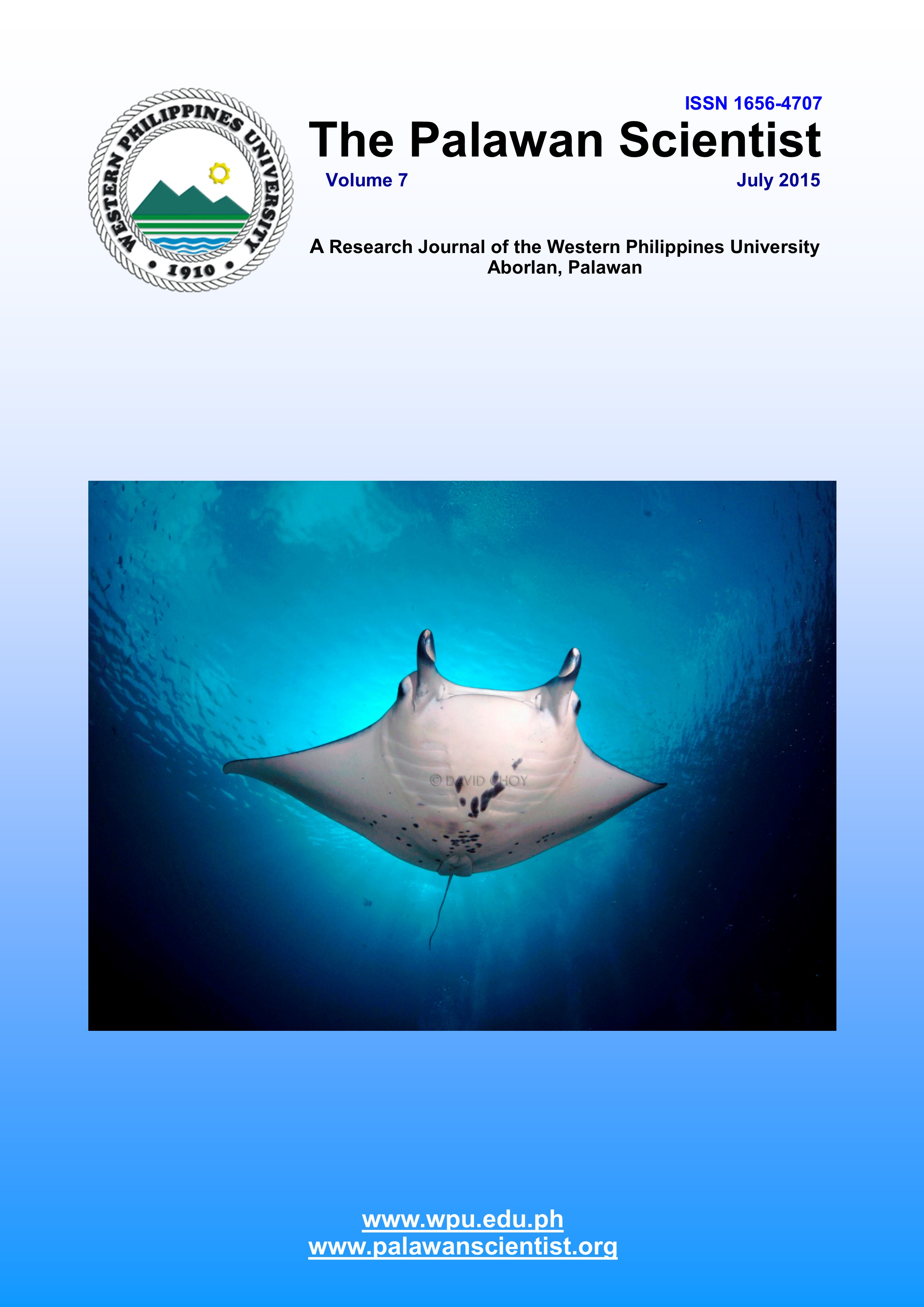
Notes on the presence of Manta alfredi in the Tubbataha Reefs Natural Park, Cagayancillo, Palawan, Philippines
##plugins.themes.bootstrap3.article.sidebar##
##plugins.themes.bootstrap3.article.main##
Abstract
In 2011, a review of 33 photographs of mantas taken at the Tubbataha Reefs Natural Park (TRNP), Cagayancillo, Palawan, Philippines revealed that most of the mantas photographed were clearly reef manta rays (Manta alfredi) with only one photograph of Manta birostris. Previously identified in surveys within the park as oceanic manta ray M. birostris, the presence of M. alfredi has never been established until now. Using various parameters, the pictures in the Tubbataha Management Office (TMO) database were reviewed and noted. The identification of M. alfredi was more consistently based on the presence of black marks located posterolateral to the last gill slits and between the rows of gill slits. The identification of the species was further validated by experts after viewing three photographs from the said database. This represents a new elasmobranch species record for the TRNP and, technically, for the Philippines as well. Furthermore, the confirmed presence of both globally significant species of manta rays should have a strong bearing on the conservation policies of the park as well as that of the country. Further research on population dynamics, structure and abundance is recommended. Contributing to global efforts to generate better understanding of the species through partnership with international organizations is also recommended.
How to Cite
Downloads
##plugins.themes.bootstrap3.article.details##
Manta alfredi, Tubbataha Reefs Natural Park
Compagno LJV, Last PR, Stevens JD and Alava MNR. 2005. Checklist of Philippine Chondrichthyes. CSIRO Marine Laboratories Report, 243. 103 pp.
Department of Agriculture-Bureau of Fisheries and Aquatic Resources (DA-BFAR). 1998. Fisheries Administrative Order 193 Series of 1998. www.bfar.da.gov.ph/pages/legislation/FAO/fao193.html. Accessed on 9 October 2012.
Eschmeyer WN. 2012. Catalog of Fishes; California Academy of Sciences.
http://research.calacademy.org/research/ichthyology/catalog/fishcatmain.asp. Accessed on 26 September 2012.
Fishbase. 2012. Manta alfredi picture (Mabir_u4.jpg) by Robert Yin. http://fishbase.org/photos/PicturesSummary.php?StartRow=1&ID=65179&what=species&TotRec=7 . Accessed on 9/26/2012.
Kashiwagi T, Marshall AD, Bennett MB and Ovenden JR. 2012. The genetic signature of recent speciation in manta rays (Manta alfredi and M. birostris). Molecular Phylogenic Evolution, 64: 212-218.
Marshall AD, Compagno LJV and Bennett MB. 2009. Redescription of the genus Manta with resurrection of Manta alfredi (Krefft, 1868) (Chondrichthyes; Myliobatoidei; Mobulidae). Zootaxa, 2301: 1-28.
National Library of Australia. 2014. The Prince Alfred Ray, Ceratoptera alfredi, Gerard Krefft (picture), National Library of Australia, vn3426138. (http://nla.gov.au/nla.pic-vn3426138, downloaded 9/27/2014).
Palawan Council for Sustainable Development (PCSD). 2004. Resolution No. 04-226. Resolution adopting the list of threatened terrestrial and marine wildlife species in Palawan and other categories, and the list of other wildlife species pursuant to Republic Act no. 9147, otherwise known as the Wildlife Resources Conservation And Protection Act of 2001.
Schultz LP. 1953. Family Mobulidae: Devil Rays; Manta. In: LP Schultz, ES Herald, EA Lachner, AD Welander and LP Woods. Fishes of the Marshall and Marianas Islands. Vol. 1. US Government Printing Office, Washington. pp. 20-22.
Stead DG. 1906. Sharks and Rays (Sub-class Elasmobranchii). In: Stead SD. Fishes of Australia; a popular and systematic guide to study of the wealth within our seas. William Brooks and Co, Ltd, Sydney. p. 238.
Tubbataha Management Office. 2011. Management Plan: Tubbataha Reefs Natural Park and World Heritage Site; 2011-2021. Tubbataha Protected Area Management Board. 31 pp.
Villanoy CL, Silvano K and Palermo JD. 2004. Tubbataha Reef and Sulu Sea Oceanographic Study. Terminal Report submitted to WWF-Philippines. 35 pp.
Whitley GP. 1932. Studies in ichthyology. Records of the Australian Museum. 18(6): 327-329. DOI: 10.3853/j.0067-1975.18.1932.737

This work is licensed under a Creative Commons Attribution-NonCommercial 4.0 International License.