
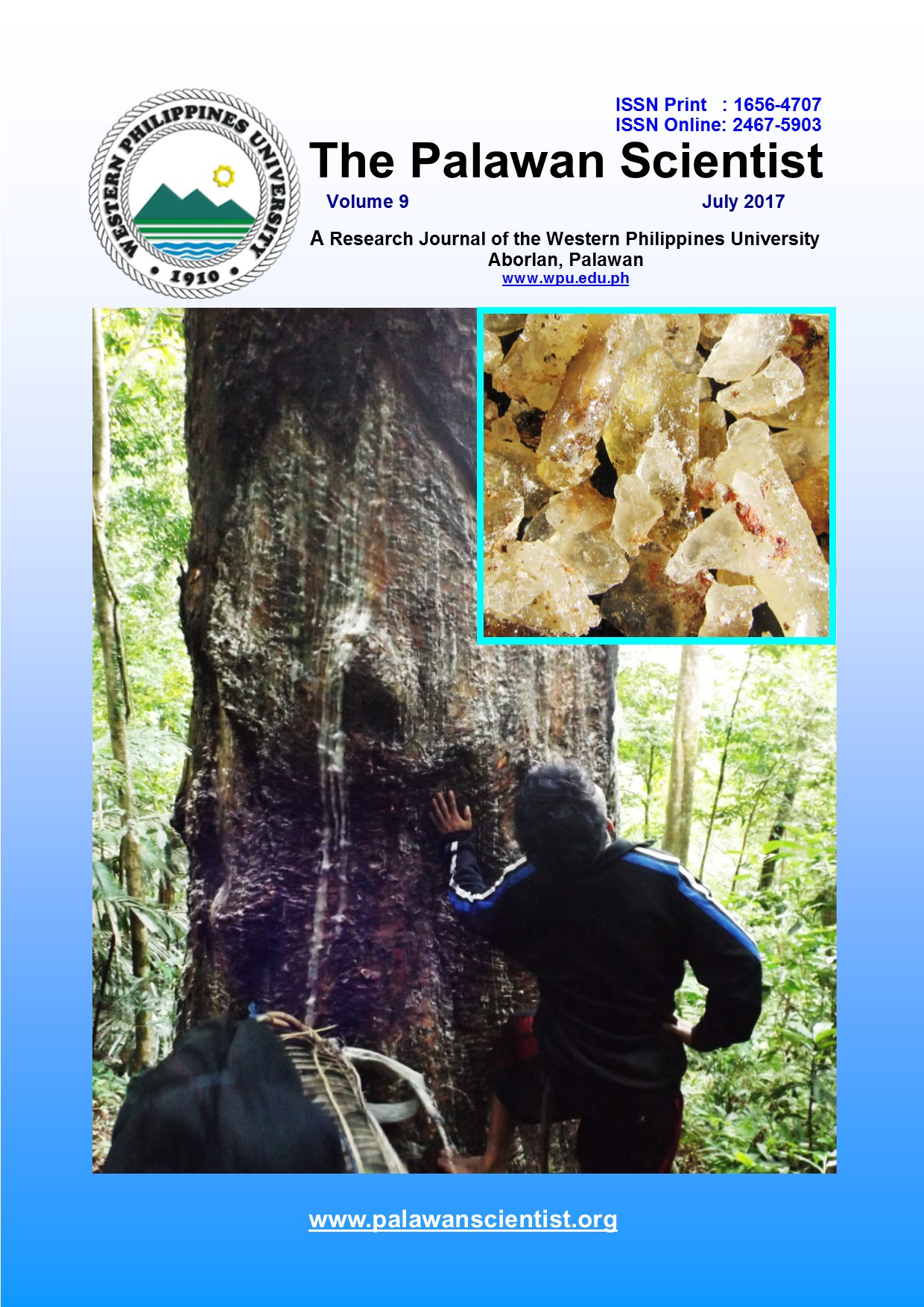
Effects of resin harvesting on the status of the Agathis philippinensis population in the Cleopatra’s Needle Critical Habitat, the Philippines
##plugins.themes.bootstrap3.article.sidebar##
##plugins.themes.bootstrap3.article.main##
Abstract
In Palawan, the Philippines, a biological hotspot was turned into a protected area, called Cleopatra’s Needle Critical Habitat (CNCH). The most important goals of the CNCH are to conserve the rich endemic biodiversity and to maintain the culture of the Batak, a group of indigenous people who depend on forest resources for their livelihood. As resin extraction from Agathis philippinensis is a key component of the income of the Batak people, it is important to study the scope for sustainable exploitation of this species. This study focused on the effects of resin harvesting on the physical status and mortality of A. philippinensis trees in 15 subpopulations within the CNCH. These population characteristics were related to the intensity of resin harvest and the distance to communities. We found that the physical tree status deteriorated and the proportion of dead trees increased with harvest intensity and proximity to communities. These results indicate that overharvesting of the resource is taking place, which may lead to prolonged recruitment failure and population decline of A. philippinensis in the study area.
How to Cite
Downloads
##plugins.themes.bootstrap3.article.details##
Agathis philippinensis, Batak, bark removal, resin extraction, unsustainable harvest
Clark DB, Hurtado J and Saatchi SS. 2014. Tropical Rain Forest Structure, Tree Growth and Dynamics along a 2700-m Elevational Transect in Costa Rica, PloS one, 10(4). e0122905
CS (Centre for Sustainability). 2014. Saving the Almaciga Tree, Palawan, Philippines.
Delvaux C. 2009. Responses to bark harvesting of medicinal tree species from Forêt Classée des Monts Kouffé, Benin. Doctoral dissertation, Université de Ghent, Belgique.
Dijkman MJ. 1951. Hevea: thirty years of research in the Far East. The chronica botanica co, Waltham, mass: USA. 348p.
Eder JF. 1987. On the road to tribal extinction: depopulation, deculturation, and adaptive well-being among the Batak of the Philippines. University of California Press.
Ella AB. 2008. Almaciga resin gathering by indigenous people of Palawan province in the Philippines. IUFRO World Series, 21, 46p.
Ella AB, and Domingo EP. 2012. Almaciga (Agathis philippinensis Warb.): Valuable but Diminishing Tree Species in the Philippines. IUFRO World Series Vol. 30, 75p.
Eshete A, Teketay D, Lemenih M and Bongers F. 2012. Effects of resin tapping and tree size on the purity, germination and storage behavior of Boswellia papyrifera (Del.) Hochst. seeds from Metema District, northwestern Ethiopia. Forest Ecology and Management, 269: 31-36.
FAO. 2011. Forest Cover, Forest types, Breakdown of forest types, Change in Forest Cover, Primary forests, Forest designation, Disturbances affecting forest land, Value of forests, Production, trade and consumption of forest products, p217-327. The Food and Agriculture Organization of the United Nations’ Global Forest Resources Assessment (2005 and 2010).
Gaoue OG and Ticktin T. 2008. Impacts of bark and foliage harvest on Khaya senegalensis (Meliaceae) reproductive performance in Benin. Journal of Applied Ecology, 45(1): 34-40.
Gaoue OG and Ticktin T. 2010. Effects of harvest of nontimber forest products and ecological differences between sites on the demography of African mahogany. Conservation Biology, 24(2): 605-614.
Guedje NM, Zuidema PA, During H, Foahom B and Lejoly J. 2007. Tree bark as a non-timber forest product: The effect of bark collection on population structure and dynamics of Garcinia lucida Vesque. Forest Ecology and Management, 240(1): 1-12.
Halos SC and Principe EB. 1978. The vanishing almaciga (Agathis philippinensis) of Samar, Philippines [gymnosperms]. Forest Genetic Resources Information (FAO).
Kärkkäinen M. 1981. Increasing resin content in pine and spruce stemwood for higher by-product yield. Communicationes Instituti Fore-stalis Fenniae, 96: 1–81
Ngubeni N. 2015. Bark re-growth and wood decay in response to bark stripping for medicinal use. MS Thesis, University of Stellenbosch. 112p.
Prooijen G. 2008. Stadsbomen Vademecum, boomcontrole en onderzoek. 3.6 Groeiringanalyse. IPC Groene Ruimte Arnhem.
Rainforest trust. 2013. Saving Palawan's Endemic Wildlife, Philippines. Online available: https://www.rainforesttrust.org/projects/complete-projects/palawan-island-philippines/. Accessed on 22 April 2015.
Rijkers T, Ogbazghi W, Wessel M and Bongers F. 2006. The effect of tapping for frankincense on sexual reproduction in Boswellia papyrifera. Journal of Applied Ecology, 43(6): 1188-1195.
Ticktin T. (2004). The ecological implications of harvesting non‐timber forest products. Journal of Applied Ecology, 41(1): 11-21.
Vermeulen WJ. 2009. The sustainable harvesting of non-timber forest products from natural forests in the southern Cape, South Africa: Development of harvest systems and management prescriptions. Doctoral dissertation, Department of Conservation Ecology and Entomology, Stellenbosch University, Stellenbosch. 210p.
Westphal E and Jansen PCM. 1989. Plant resources of South-East Asia: a selection. Pudoc. 322p.

This work is licensed under a Creative Commons Attribution-NonCommercial 4.0 International License.