
Population status and lunar periodicity of spawning of Tripneustes gratilla (Echinodermata: Echinoidea), in Jose Abad Santos, Davao Occidental, Philippines
##plugins.themes.bootstrap3.article.sidebar##
##plugins.themes.bootstrap3.article.main##

Abstract
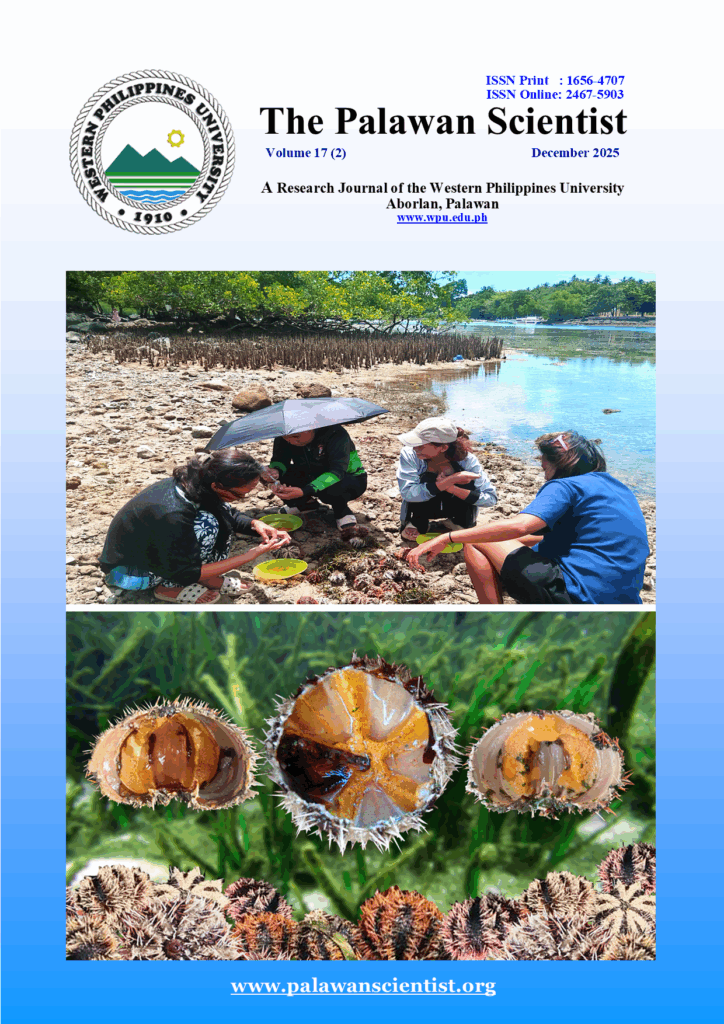
The population structure and lunar periodicity of spawning were investigated from January to February 2024 across three sites in Jose Abad Santos, Davao Occidental, Philippines. Monthly field surveys were conducted using the belt transect method to assess population structure, while laboratory analyses were performed to examine the lunar periodicity of spawning across different lunar phases. A total of 160 individuals of Tripneustes gratilla (Linnaeus 1758) were recorded with an estimated mean density of 645.83 ± 171.50 ind ha-1 and mainly dominated by adult size classes having a test diameter (TD) of 61 - 65 mm followed by pre-adults of 51 - 55 mm TD and only very few recruits 33 – 40 mm TD. The relationship between the TD and weight of T. gratilla displayed a high positive correlation. It exhibited a negative allometric growth with a b value of less than 3 in three sites. The result of the gonad index (GI) and fecundity showed that the highest GI and total number of eggs occurred during the full moon while the lowest occurred during the new moon with notes on sexual maturity at 54 mm TD. While the findings of this study provide valuable insights, they are not conclusive regarding the population structure and lunar spawning periodicity, as the study was conducted over only two months. Long-term monitoring is needed for a more accurate understanding of the status of T. gratilla at these sites.
How to Cite
Downloads
##plugins.themes.bootstrap3.article.details##
fecundity, gonad index, lunar phase, size structure, test diameter-weight relationship
Andrew NL, Agatsuma Y, Ballesteros E, Bazhin AG, Creaser EP, Barnes DKA, Botsford LW, Bradbury A, Campbell A, Dixon JD et al. 2002. Status and management of world sea urchin fisheries. Oceanography and Marine Biology Annual Review, 40: 343–425. https://doi.org/10.1201/9780203180594.ch7.
Aparecida Y, Garcia T, Carlos and Borzone A. 2015. The reproductive cycle of the sea urchin Lytechinus variegatus (Echinodermata: Echinoidea) in southern Brazil. Revista de Biologia Tropical, 63: 243–250. http://dx.doi.org/10.15517/rbt.v63i2.23158
Balisco RAT. 2015. Notes on the gracious sea urchin Tripneustes gratilla (Echinodermata: Echinoidea) in Pag-asa Island, Kalayaan, Palawan, Philippines. The Palawan Scientist, 7: 28–36. https://doi.org/10.69721/TPS.J.2015.7.1.03
Bangi H, Cuaresma G, Quimpo GFT, Bollozos CJ and Roa-Quiaoit HA. 2013. Preliminary observations on the recruitment variability in Tripneustes gratilla (echinodermata: echinoidea) in three selected biogeographic regions in the Philippines. Galaxea, Journal of Coral Reef Studies, 15(Supplement): 107–114. https://doi.org/10.3755/galaxea.15.107
Basch LV and Tegner MJ. 2007. Reproductive responses of purple sea urchin (Strongylocentrotus purpuratus) populations to environmental conditions across a coastal depth gradient. Bulletin of Marine Science, 81(2): 255–282.
Bin Nurhasan R, Akmar S, Binti K and Rahim A. 2011. Sea urchin fishery practices in Sabah. International Fisheries Symposium, 5-9.
Brockington S, Clarke A and Chapman ALG. 2001. Seasonality of feeding and nutritional status during the austral winter in the Antarctic sea urchin Sterechinus neumayeri. Marine Biology, 139: 127–138. https://doi.org/10.1007/s002270100561
Cailliet GM, Love MS and Ebeling AW. 1986. Fishes: A field and laboratory manual on their structure, identification and natural history. Wadsworth Publishing Company. Belmont, California. 194pp.
Coppard S and Campbell A. 2005. Distribution and abundance of reglar sea urchins on two coral reefs in Fiji. Micronesica, 37(2): 249-269.
Dincer T and Cakli S. 2007. Chemical composition and biometrical measurements of the Turkish sea urchin (Paracentrotus lividus, Lamarck, 1816). Critical Reviews in Food Science and Nutrition, 47(1): 21–26. https://doi.org/10.1080/10408390600550265
Eklöf JS, de la Torre-Castro M, Gullström M, Uku J, Muthiga N, Lyimo T and Bandeira SO. 2008. Sea urchin overgrazing of seagrasses: A review of current knowledge on causes, consequences, and management. Estuarine, Coastal and Shelf Science, 79(4): 569-580. https://doi.org/10.1016/j.ecss.2008.05.005
Elmasry E, Abdelrazek FA and El-Sayed AM. 2023. Growth pattern and population status of the sea urchin Paracentrotus lividus (Lamarck, 1816) on the Meditteranean coast of Egypt. Egyptian Journal of Aquatic Research, 49(3): 409-416. https://doi.org/10.1016/j.ejar.2023.07.001
Furkon, Nessa N, Ambo-Rappe R, Cullen-Unsworth LC and Unsworth RKF. 2020. Social-ecological drivers and dynamics of seagrass gleaning fisheries. Ambio, 49(7): 1271–1281. https://doi.org/10.1007/s13280-019-01267-x
Furkon, Nessa MN and Ambo-Rappe R. 2019. Invertebrate Gleaning: Forgotten Fisheries. In IOP Conference Series: Earth and Environmental Science, 253: 012029. https://doi.org/10.1088/1755-1315/253/1/012029
Gaudette J, Wahle RA and Himmelman JH. 2006. Spawning events in small and large populations of the green sea urchin Strongylocentrotus droebachiensis as recorded using fertilization assays. Limnology and Oceanography, 51(3): 1485–1496. https://doi.org/10.4319/lo.2006.51.3.1485
Holden MJ and Raitt DFS. 1974. Manual of Fisheries Science Part 2. Methods of resource investigation and their application. FAO Fisheries Technical Paper no. 115. Food and Agriculture Organization, Rome. 255pp.
James P and Siikavuopio S. 2012. A guide to the sea urchin reproductive cycle and staging sea urchin gonad samples. Norwegian Institute of Food, Fishery and Aquaculture. 20pp.
Johnson DW and Ranelletti ME. 2017. Natural spawning of a Hawaiian sea urchin, Tripneustes gratilla. Invertebrate Biology, 136(1): 31–36. https://doi.org/10.1111/ivb.12158
Juinio-Meñez MA, Macawaris ND and Bangi HG. 1998. Community-based sea urchin (Tripneustes gratilla) grow-out culture as a resource management tool. Canadian Special Publication of Fisheries and Aquatic Sciences, 125: 393-399.
Juinio-Meñez MA, Bangi HG and Malay MC. 2008a. Effect of type of feed, stocking density, and grow-out site on gonad index, growth and survivorship of cultured sea urchin (Tripneustes gratilla). Philippine Agricultural Scientist, 91(4): 439-449.
Juinio-Meñez MA, Bangi HG, Malay MC and Pastor D. 2008b. Enhancing the recovery of depleted Tripneustes gratilla stocks through grow-out culture and restocking. Reviews in Fisheries Science, 16(1–3): 35–43. https://doi.org/10.1080/10641260701678116.
Kasim M. 2009. Grazing activity of the sea urchin Tripneustes gratilla in tropical seagrass beds of Buton Island. Journal of Coastal Development, 13(1): 19–27.
Lawrence JM, Lawrence AL and Holland ND. 1965. Annual cycle in the size of the gut of the purple sea urchin, Strongylocentrotus purpuratus (Stimpson). Nature, 205: 1238-1239. https://doi.org/10.1038/2051238a0
Lawrence JM. 1975. On the relationships between marine plants and sea urchins. Oceanography and Marine Biology Annual Review, 13: 213–286.
Lawrence JM and Agatsuma Y. 2007. Chapter 24 Ecology of Tripneustes. In: Lawrence JM (ed). Developments in Aquaculture and Fisheries Science, 37: 499–520. https://doi.org/10.1016/S0167-9309(07)80088-3
Lawrence JM and Agatsuma Y. 2013. Chapter 32 - Tripneustes. In: Lawrence JM (ed). Developments in Aquaculture and Fisheries Science, 38: 491-507. https://doi.org/10.1016/B978-0-12-396491-5.00032-0
Lutfiyani E, Pringgenies D and Endrawati H. 2021. Studi histologi tingkat kematangan gonad jantan and betina bulu babi Diadema setosum di Pulau Panjang Jepara. Majalah Ilmiah Biologi BIOSFERA: A Scientific Journal, 38: 29-33. [Indonesian].
Küçükdermenci A, Lök A, Acarlı S, Yiğitkurt S, Kırtık A and Kurtay E. 2017. Quantitative and qualitative observations of European sea urchin (Paracentrotus lividus, Lamarck 1816) gonad in Cesme Bay, Izmir, Turkey. Ege Journal of Fisheries and Aquatic Sciences, 34(3): 277–280. https://doi.org/10.12714/egejfas.2017.34.3.05
Mon EE, Zin PP and Dwe KL. 2020. Length-weight relationship, condition factor, and sex ratio of tade mullet (Liza tade Forsskal, 1775) from Mawlamyine, Mon state, Myanmar. Journal of Aquaculture and Marine Biology, 9(4): 107-112. https://doi.org/10.15406/jamb.2020.09.00285
Muthiga NA. 2005. Testing for the effects of seasonal and lunar periodicity on the reproduction of the edible sea urchin Tripneustes gratilla (L) in Kenyan coral reef lagoons. Hydrobiologia, 549(1): 57–64. https://doi.org/10.1007/s10750-005-4757-2
Nane L and Paramata AR. 2020. Impact of overfishing on density and test-diameter size of the sea urchin Tripneustes gratilla at Wakatobi archipelago, South-Eastern Sulawesi, Indonesia. Ilmu Kelautan: Indonesian Journal of Marine Sciences, 25(2): 53–56. https://doi.org/10.14710/ik.ijms.25.2.53-56
Nasrullah R, Sari W and Mellisa S. 2018. Gonadal maturity of sea urchins (Tripneustes gratilla) at Ahmad Rhangmayang beach sub-district of Mesjid Raya Aceh Besar District. Unsyiah Maritime and Fisheries Student Scientific Journal, 3(1): 23-32.
Pauly D. 1984. Fish Population Dynamics in Tropical Waters: A Manual for Use with Programmable Calculators. International Center for Living Aquatic Resources Management, Manila, Philippines. 325pp.
Perez AF, Boy C, Morriconi E and Calvo J. 2010. Reproductive cycle and reproductive output of the sea urchin Loxechinus albus (Echinodermata: Echinoidea) from Beagle Channel, Tierra del Fuego, Argentina. Polar Biology, 33(3): 271–280. https://doi.org/10.1007/s00300-009-0702-6
Prado VV, Galvez GN and Rivera R. 2012. Size structure and density of sea urchin Tripneustes gratilla along Balaoan waters, La Union, Philippines. International Scientific Research Journal, 4(3): 197-203.
Pulz O and Gross W. 2004. Valuable products from biotechnology of microalgae. Applied Microbiology and Biotechnology, 65(6): 635-648. https://doi.org/10.1007/s00253-004-1647-x
Rahman MA, Yusoff FM, Arshad A, Amin SMN and Shamsudin MN. 2013. Population characteristics and fecundity estimates of short-spined white sea urchin, Salmacis sphaeroides (Linnaeus, 1758) from the coastal waters of Johor, Malaysia. Asian Journal of Animal and Veterinary Advances, 8(2): 301–308. https://doi.org/10.3923/ajava.2013.301.308
Rahman MA, Ismail M, Parvez MS, Asadujjaman M, Ashik AA and Molla MHR. 2022. Echinoderm fisheries: their culture, conservation, bioactive compounds and therapeutic applications. Journal of Biological Studies, 5(3): 413–443. https://doi.org/10.62400/jbs.v5i3.7053
Regalado JM, Campos WL and Santillan AS. 2010. Population biology of Tripneustes gratilla (Linnaeus) (Echinodermata) in seagrass beds of southern Guimaras, Philippines. Science Diliman, 22(2): 41-49.
Siddique S and Ayub Z. 2016. Length-weight relationships and condition factor of the sea urchin Echinmetra matthaei (Echinodea: Echinodermata) on Buleji rocky shore of Karachi, Pakistan. Pakistan Journal of Marine Science, 25(1&2): 161-171.
Sonu SC. 2017. Sea urchin supply, demand, and market of Japan. US Department of Commerce. National Oceanic and Atmospheric Administration National Marine Fisheries Service. 44pp. https://www.st.nmfs.noaa.gov/Assets/commercial/market-news/00-Sea-urchin-Reports-Final-Nov-8-2018-2019.pdf. Accessed on 28 September 2024.
Suryanti S, Anggoro SA, In C and Widyorini N. 2024. Osmoregulation pattern, condition factor, and gonadal maturity level of sea urchins in the various ecosystems of Panjang Island, Jepara, Indonesia. Biodiversitas, 25(2): 502–509. https://doi.org/10.13057/biodiv/d250208
Tamti H, Rappe RA, Andy Omar SB and Budimawan. 2021. Preliminary assessment of Tripneustes gratilla populations in seagrass beds of the Spermonde Archipelago, South Sulawesi, Indonesia. In IOP Conference Series: Earth and Environmental Science 763: 012008. https://doi.org/10.1088/1755-1315/763/1/012008
Toha AHA, Sumitro SB, Hakim l., Widodo N, Binur R, Suhaemi S and Anggoro AW. 2017. Review: Biology of the commercially used sea urchin Tripneustes gratilla (Linnaeus, 1758) (Echinoidea: Echinodermata). Ocean Life, 1(1): 1–10. https://doi.org/10.13057/oceanlife/o010101
Tuason AY and Gomez ED. 1979. The reproductive biology of Tripneustes gratilla Linnaeus (Echinoidea: Echinodermata) with some notes on Diadema setosum Leske. In: Proceedings of the International Symposium on Marine Biogeography and Evolution in the Southern Hemisphere, 2: 707-716.
Ungson J. 2004. Stock enhancement of sea urchin (Tripneustes gratilla) in Northwestern Luzon, Philippines. A Management Strategy. IIFET 2004 Japan Proceedings. Tokyo. 10pp.
Vaïtilingon D, Rasolofonirina R and Jangoux M. 2005. Reproductive cycle of edible echinoderms from the southwestern Indian ocean I. Tripneustes gratilla L. (Echinoidea, Echinodermatata). Western Indian Ocean Journal of Marine Science, 4: 47–60. https://doi.org/10.4314/wiojms.v4i1.28473
Vladimir PG, Masuda Y and Matsuoka T. 2004. Age, growth, and reproduction of yellowbelly Threadfin Bream Nemiterus bathbybiu in Kagoshima Bay, Southern Japan. Fisheries Science, 70(3): 497-506. https://doi.org/10.1111/j.1444-2906.2004.00831.x
Wallner-Hahn S, de la Torre-Castro M, Eklöf JS, Gullström M, Muthiga NA and Uku J. 2015. Cascade effects and sea-urchin overgrazing: An analysis of drivers behind the exploitation of sea urchin predators for management improvement. Ocean and Coastal Management, 107: 16–27. https://doi.org/10.1016/j.ocecoaman.2015.01.010
Zhadan PM, Vaschenko MA and Ryazanov SD. 2018. Assessing the effect of environmental factors on the spawning activity of the sea urchin Strongylocentrotus intermedius through video recording observations. Marine Ecology Progress Series, 588: 101–119. https://doi.org/10.3354/meps12436

This work is licensed under a Creative Commons Attribution-NonCommercial 4.0 International License.